The Hidden Reconciliation Step Fragmented Wedding Tools Force You to Own
Fragmented tools force couples to manually sync RSVPs, seating and budgets before the big day.
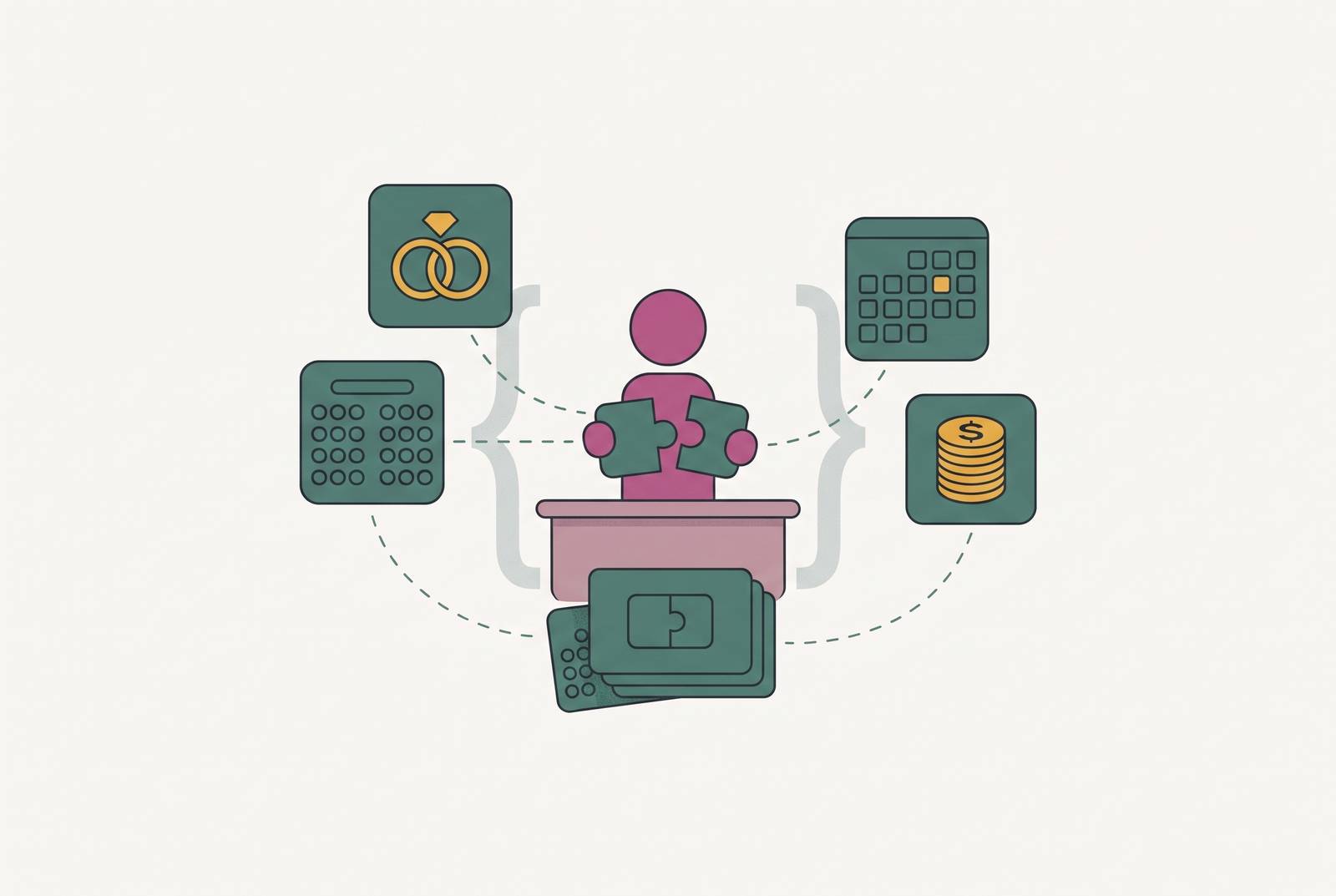
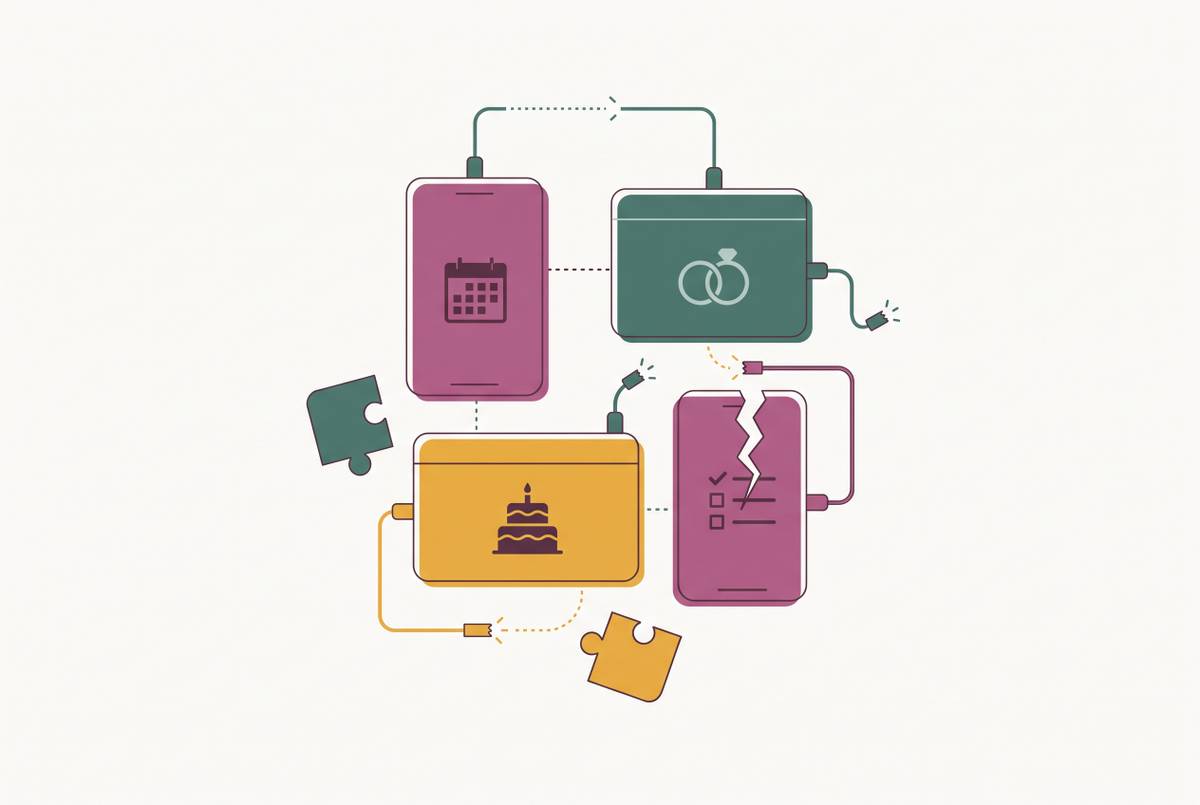
Disconnected wedding planning tools leave couples with a hidden job, keeping RSVPs, dietary needs, seating, vendor quotes and budgets in sync by hand. That reconciliation work piles up just when final numbers, catering instructions and payments need to be right.
Why wedding planning tools end up in separate silos in the first place
The dominant tools grew around vendor marketplaces and aesthetic templates. A vendor directory makes its money from supplier advertising and enquiry leads. The planning features give couples a reason to stay on the platform. Deep connections between RSVPs, seating and budgets do not generate that advertising revenue, so the business model does not reward them in the same way.
Finding a supplier, collecting replies and arranging tables are separate jobs from a product’s point of view, even though they depend on one another during planning. A tool can do its own job well without passing the right information to the next one. The handoff still has to happen somewhere. When the products do not handle it, the couple becomes the link between them.
The reconciliation job no one tells couples they are signing up for
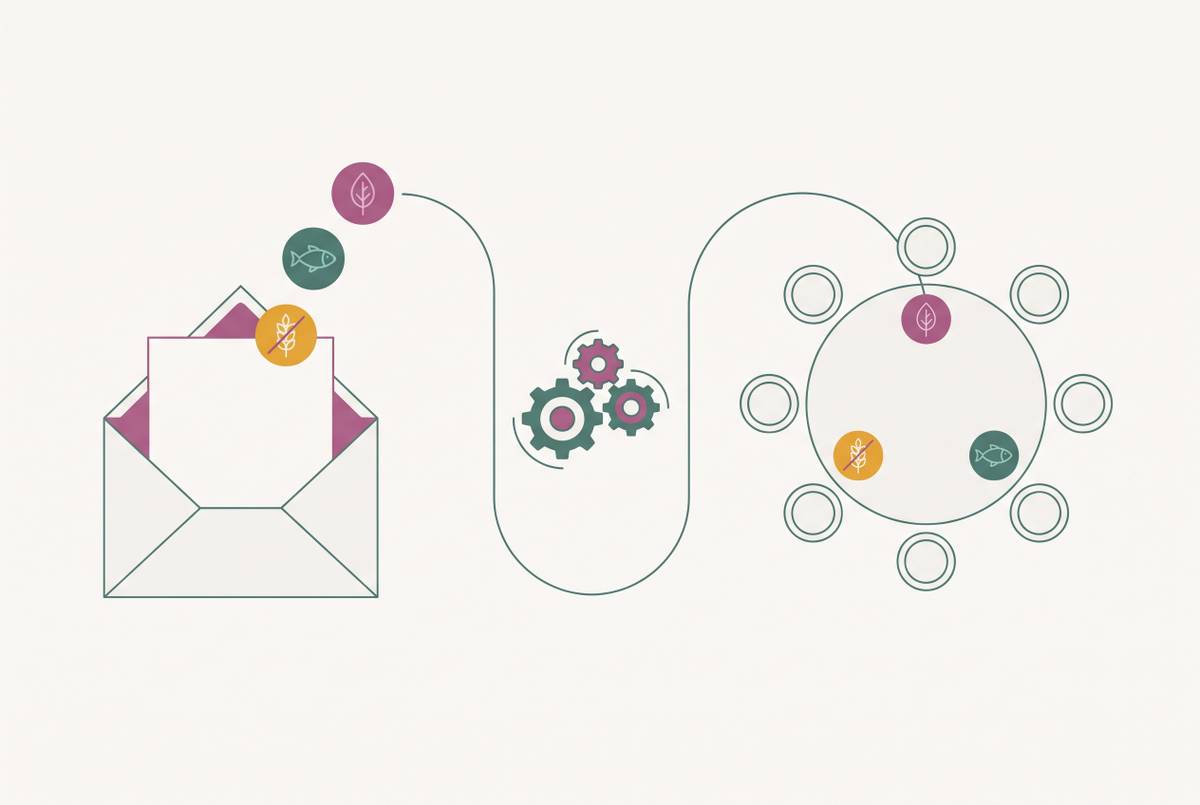
An RSVP arrives through the wedding website with a name and a dietary note. The couple copies both into a separate guest list, then opens the seating tool to add the guest there too. Later, the guest adds a plus-one or changes the dietary requirement. Every affected record needs another visit and another correction. Nothing in the seating tool necessarily flags that the reply has changed elsewhere.
That is reconciliation, keeping separate versions of the same information consistent. It reaches beyond guests and tables. A vendor quote arrives in an enquiry thread, but its price must be copied into a budget tracker with no connection to that conversation. If the category total changes, the couple sees the effect only if they remember to check. The work lives between tools, so it rarely appears as a task inside any one of them.
Reconciliation spikes when RSVPs close, when the seating plan must be built, when dietary counts go to the caterer and when vendor invoices arrive. Planning only one wedding does not make that workload harmless. The overhead may be finite, but much of it lands in a compressed final window with little slack. A correction that looks small on its own competes with every other handoff due at the same time.
Where the dietary data gap causes the most damage
Guest names can transfer cleanly from an RSVP tool to a seating chart while meal requirements fall away at the seating step. The chart then answers who sits where, but not which seat needs the gluten-free plate or the halal meal. A successful name transfer is not enough. The useful unit is the guest record with the dietary information still attached.
Australian weddings can need more detail than fits well in a single freeform dietary box. In cities such as Sydney and Melbourne, a guest list can include halal and kosher requirements, allergies and personal preference diets. Those requirements must stay with the right person when seats change. A summary count cannot do that job. “Three gluten-free guests” does not tell the caterer which three seats need those meals during service.
Most Australian caterers and venue coordinators require a finalised seating plan well before the event. When replies and seating live in separate tools, the couple must assemble that per-seat dietary map manually before the handoff. Any late change means finding and correcting the affected records under time pressure. If a guest with a severe allergy is seated at the wrong table and the dietary record does not follow, service information points to the wrong place. The gap is no longer just an untidy guest list.
How the same fragmentation problem makes budget overruns invisible until it's too late
The same failure appears in the budget when a vendor’s current price stays in an enquiry thread while an earlier estimate remains in the tracker. Quotes, invoices and payment figures can each be right in their own place but still fail to match. The budget then shows less spending than the couple has committed to. No one sees the difference until someone checks the records against each other, often when a final invoice arrives.
The gap between what Australian couples initially budget and what they actually spend is consistent and large. Disconnected tools make that gap harder to see as it develops. Guest count is the primary cost lever. Each extra guest adds to the cost of catering, beverages and table settings, but a guest list kept apart from the budget cannot update it automatically.
Category estimates can reinforce that false confidence. They show what the couple intended to spend. Individual vendor payments may already have drifted beyond their allocations while the tracker still displays the original plan. Although fragmentation does not cause every overrun, the structure hides incremental drift that couples need to see while planning, before payment is due.
The planning timeline sequence that turns fragmentation into a cascade of manual work
In Australia, the choices couples make depend on one another long before invitations go out. At 12–18 months, the budget, guest list, venue and photographer establish the early shape of the wedding. The guest list already informs spending and venue decisions. If those records are kept apart, the work of keeping them in step starts here. There does not need to be a mistake for reconciliation work to exist.
At 9–12 months, the sequence moves to the celebrant and caterer, with the Notice of Intended Marriage also part of the planning. That notice is a legal requirement in Australia and must be lodged at least one month before the ceremony. At 6–9 months, save-the-dates and remaining vendors extend the information that has to stay current. The guest list now informs who receives a send-out, while vendor quotes need to reach the budget.
Formal invitations go out at 8–12 weeks with an RSVP deadline. The guest list must change as replies come in, the caterer must get the confirmed numbers, and guests’ dietary requirements must go into the seating plan with them. This is the biggest choke point. The RSVP deadline needs to be at least three to four weeks before the wedding to leave time to chase non-responders, confirm numbers with the venue and caterer, and build seating. Separate tools consume part of that window through repeated entry.
By 2–3 weeks, final numbers are confirmed and the run sheet is shared with all vendors. The seating chart must also reach the venue with the right dietary information attached. A late reply now affects more than the invitation record. It can require changes to the guest list, seating, catering information and budget, all close to their final handoffs. The timeline tightens because each new update has more downstream records to catch up with.
Why adding AI to individual tools hasn't closed the gap
AI can improve a planning tool without improving its connection to anything else. Budget forecasting is a clear example. A forecast can become more capable, but if it has no connection to the guest list, it still works from stale numbers after the headcount changes. The couple must supply the update before that intelligence can help.
Australian couples also face a separate fit problem when AI uses US pricing and workflow assumptions. Confident answers based on those assumptions can be inapplicable to an Australian wedding. Better presentation does not fix the mismatch. An AI feature needs both data that fits the local wedding and links to other tools, and it can lack either. Adding intelligence inside a tool therefore does not, by itself, remove the manual work at the boundary between tools.
Smarter features can make individual planning tasks easier. But a feature that helps with seating still leaves the dietary handoff unresolved if meal requirements do not arrive with the guests. The test is what information reaches the feature and where its output goes next.
What a connected system actually eliminates at each stage
When the whole system is connected, an RSVP updates the guest list automatically, and that list passes guests to the seating chart with their dietary data attached. A seating change is reflected in what the caterer receives. A vendor quote goes into the budget as soon as it is entered, with no need to type it again. The couple still decides how to plan the wedding, but no longer has to enter each decision in separate records.
For dietary information, that connection replaces a procedure with a built-in relationship. The meal requirement stays with the guest at each step of planning, so the system can make the caterer’s per-seat map automatically. It does not have to be assembled from replies and seating records in the final days. The same consistency supports a QR-code seat finder, which directs guests to their tables when they scan a code on the day.
On the financial side, an accountant-designed budget planner that tracks actual invoices and payment milestones gives a different view from a sheet of category estimates. It can expose overrun drift as it happens rather than leaving an old allocation untouched until final reconciliation. When guest information, vendor comparisons and the budget are connected, changes can reach the planning records that depend on them. The benefit is less copying and earlier visibility.
How to evaluate whether your current tool stack is creating reconciliation work
To test the tools you use now, look at how they work together as well as what each feature does on its own. A deliberate two-tool stack, with one tool for vendor discovery and another for planning, is a legitimate approach. Its handoff needs to be a planned task that the couple knowingly owns. Separation itself is not the surprise to avoid. The surprise is discovering, near a deadline, that no tool has been keeping the records aligned.
Check whether the tool uses AUD natively, whether its budget benchmarks reflect how costs vary from state to state in Australia, and whether its dietary categories cover the requirements of the guests on the list.
When a guest RSVPs, does the dietary requirement automatically appear in your seating chart, or do you copy it across? When you add a guest or remove one after a late cancellation, how many places do you have to update? When a vendor sends a final invoice that differs from the quote, does your budget update automatically, or do you discover the difference at reconciliation?
Could you produce a per-seat dietary map for your caterer right now, from your planning tools, without opening a spreadsheet? If your caterer has a ten-day deadline, is your RSVP deadline early enough to leave three to four weeks between replies closing and that handoff?