Wedding Budget Spreadsheet Limitations for Australian Couples
Static spreadsheets can't track the moving costs that drive consistent overruns.
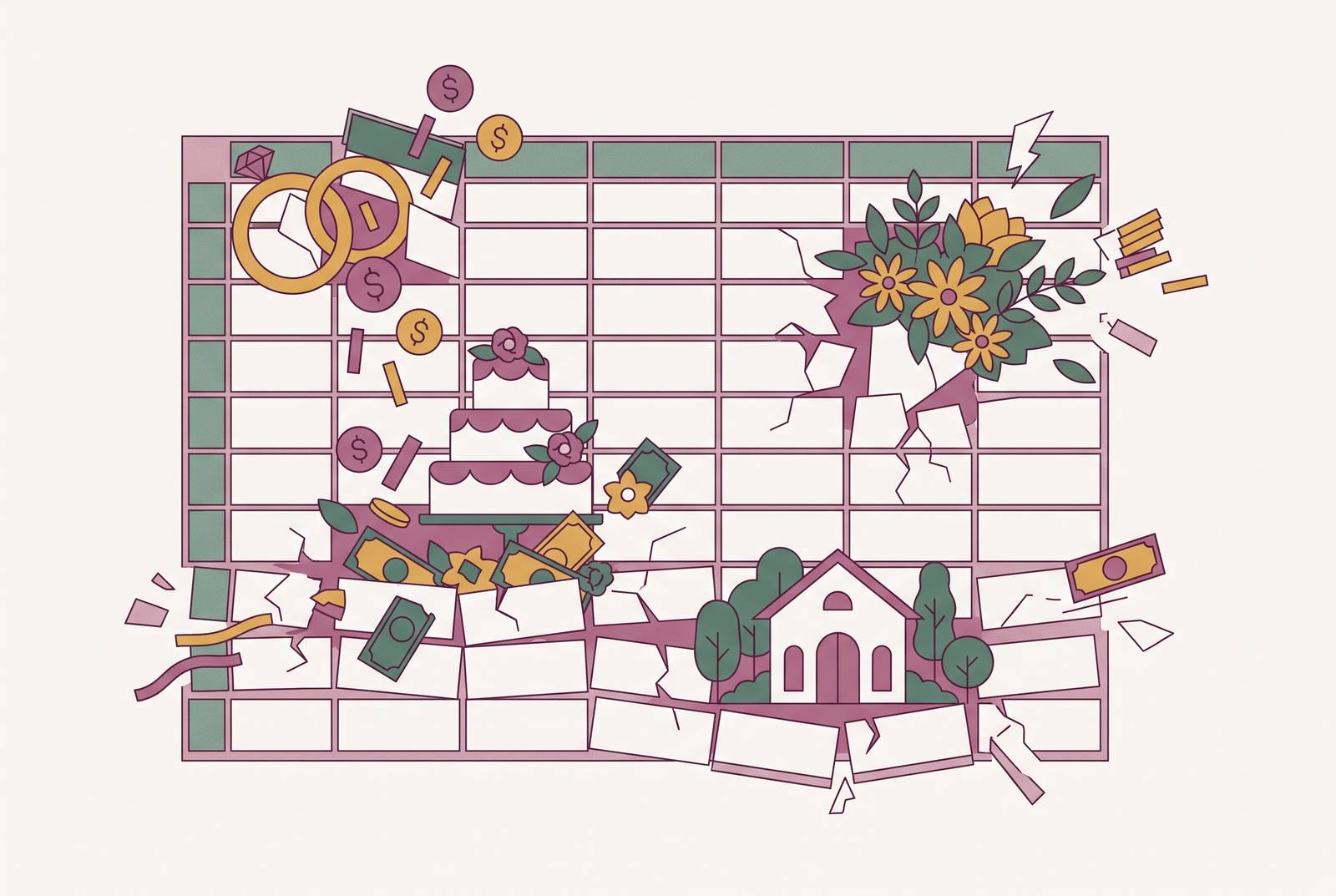
Wedding budget spreadsheet limitations for Australian couples are not just about awkward formulas. They are about using a static tracker for a financial project that keeps changing. The consistent 23% budget overrun is a structural problem, driven by shifting guest counts, staggered payments and costs the sheet never knew to include.
Why Australian couples consistently spend more than they budgeted
Australian couples overshoot their original wedding budget by 23%, a gap large enough to require post-wedding financial adjustment for most couples. Treating that gap as poor discipline misdiagnoses the problem.
A consistent overrun points to a consistent cause. Couples make decisions using a budget that appears complete, while the commitments behind it keep moving. The tracker can still look orderly even when it no longer describes the wedding being planned. Spending more carefully can only help so much when the budget hides what a choice will really cost. The question, then, is what makes the financial picture fall behind.
What makes a wedding budget structurally different from other budgets
A wedding is dozens of interdependent financial decisions made over many months. Guest count has the most power to change the cost because it affects venue capacity, catering, stationery and transport at once. Trimming a list from 120 to 70 can move the total by many thousands of dollars. Yet venue and catering, which account for nearly half of total spend on average, are often booked before couples build a budget.
Vendors take payments in stages, while their scope and the guest list can keep changing throughout the engagement. Extra charges also fall outside headline quotes, so couples may end up paying more than the package price they agreed to. In Australia's peak-season market, this moving financial picture can stretch across well over a year of active planning. A useful budget therefore has to follow relationships and obligations over time.
How a spreadsheet handles static data well and dynamic data badly
A spreadsheet handles stable inputs and simple relationships well. Its cells hold values, and its formulas calculate from the references someone has built. But it has no built-in understanding that an RSVP change should alter catering costs in another tab. Without that connection, the guest count can change while the food estimate stays confidently wrong.
With one or two suppliers, a couple may still hold the missing relationships in their heads. Around the third vendor, staggered payments and changing numbers make that mental model harder to sustain.
A spreadsheet that is built well can link tabs, work out balances and keep track of dates. The limitation is that the couple must design and maintain the whole structure. When couples are under pressure to plan, each supplier they add or formula they change gives them another chance to break it. A generic template offers no wedding-specific guardrails to catch the omission.
The GST problem Australian couples encounter that generic templates ignore
Australian vendor quotes do not all treat GST the same way. Some suppliers quote inclusive prices, others quote ex-GST, and some are not registered for GST at all. The last group can include sole-trader celebrants, small photographers and regional suppliers. A florist's inclusive price and the same figure from a venue plus GST are not equivalent costs.
Generic international templates built for US or UK markets may have no GST column or way to flag that distinction. Entering prices straight from proposals then puts unlike figures into what looks like a single reliable total. The error compounds as more vendors are added, then becomes visible when final invoices are reconciled. By the weeks before the wedding, the missing amount is real money with little room left to adjust.
Why per-head costs make guest list changes the most expensive spreadsheet error
A guest list change looks like one update, but its financial effect cascades through several categories. The venue and catering alone cost an average of $180–$300 per head in Australia, depending on the package. Drinks, stationery, favours and transport can also scale with attendance. Adding guests therefore changes more than the catering row, even when that is the only row someone remembers to update.
Guest numbers shift as RSVPs arrive, family circumstances change and plus-one decisions are made or reversed. Unless every relevant estimate is linked correctly, each shift requires a manual audit. Some figures get changed and others get missed, leaving a total assembled from different versions of the guest list. It looks precise because the formulas still work.
Location changes the size of that error. New South Wales couples pay more per head for the venue and catering than Queensland couples, so a national average cannot give an accurate picture of both. An early venue booking adds another constraint, namely capacity and minimum spend agreed against a guest number that may no longer fit. An unconnected tracker cannot flag that mismatch.
How deposit schedules create a false picture of budget health mid-planning
Australian vendors commonly take a fixed amount or percentage at booking, sometimes an instalment during planning, and a balance days before or on the wedding day. These payments describe one commitment at different stages. A budget needs to distinguish the total obligation from the money already paid.
Think of a couple who have paid deposits to five vendors. If their sheet records only those payments, the spend figure shows a fraction of what they have committed to. That low total can look like room for more spending when much of the money is already spoken for. Putting the full contract values in the sheet shows what the couple have agreed to pay, but the balances still need to change as instalments are paid.
Neither approach is inherently wrong. The gap comes from treating payment history and future obligations as though they were the same thing. Keeping agreed totals, deposits, instalments and confirmed extras separate is what makes the payment timeline legible.
What percentage-based budget templates get wrong for Australian couples specifically
Percentage templates offer a reassuring starting point because every category receives a share and the shares add up. The arithmetic is sound. The weakness is calibration, because average spending ratios do not establish what a particular couple values or what suppliers in their city charge. A complete allocation is not the same as a workable budget.
A New South Wales wedding averages significantly more than one in South Australia or another lower-cost state. A national-average template can therefore undershoot Sydney costs while overshooting Adelaide costs. Full-day photography in Sydney or Melbourne can reach $8,000 or more, well above what a national-average percentage might suggest.
Preferences matter as well. A couple indifferent to flowers can inherit a florals budget neither partner actually chose. Meanwhile, venue and catering may already have consumed or exceeded their assigned share before the rest of the sheet is filled in. The template remains useful as a starting structure, but its allocations are not evidence that the wedding can be bought for those amounts.
The hidden costs that spreadsheets never have a row for
Some of the most damaging omissions are costs outside the headline quote, including corkage fees, cake-cutting services, chair cover hire, ceremony amplification and supplier meals. Public liability insurance and overtime buffers can add further amounts. These charges are predictable parts of wedding planning, but they are not necessarily familiar to people hiring these services for the first time.
Almost everyone leaves the official marriage certificate, listed as the BDM registration fee, out of their early budget. Hair and makeup trials also typically require a separate booking and payment, although some artists include them in their wedding-day package. That variation matters because a category heading alone does not show what the quote covers.
A spreadsheet cannot prompt for something it has not been built to recognise. Couples who have never encountered corkage have no obvious reason to create a row for it. This is a visibility problem before it becomes a tracking problem.
When the collaboration problem turns a tracking failure into a planning failure
The budget also has to be usable by both people making spending decisions. In practice, a complex spreadsheet often belongs to the partner who built it or feels more comfortable maintaining it. Multiple tabs, cross-referenced formulas and conditional formatting can make that sheet difficult to read on a phone. Even with a shared file, both partners may not be able to see clearly where the money stands.
That gap matters during vendor conversations. A partner who cannot see current commitments cannot reliably judge whether a scope addition fits the budget. This is a two-person project depending on one person's working document.
Separate copies make the problem worse. A sheet kept on a laptop or emailed between partners can leave each person referring to a different version. Over time, the partner who has not opened the sheet in months becomes further removed from the plan while spending continues.
What a budget tool would need to do that spreadsheets cannot
A purpose-built tool needs to carry the relationships that a generic spreadsheet leaves couples to construct. Its budget should know the guest list and RSVP status, so it updates per-head estimates on its own when they change. It should also separate committed spending from payments made and show what remains due and when.
To compare vendors, couples need the same fields for each one: agreed total, GST status, deposit, instalments and confirmed extras. Default estimates should reflect Australian city costs, while prompts should expose likely omissions before an invoice does. A polished total is not enough if its inputs are incomplete.
Both partners also need the same live plan on any device, with a phone view they can actually read. The guest list, vendor comparison and budget need to be linked. When a tool keeps those areas separate, someone still has to copy changes from one to another.
Practical steps for Australian couples to fix their budget before the overrun happens
Start with the total guest count before committing to a vendor. Get the list as close to final as possible before signing, because the venue and catering decision locks in a large share of spending. Then normalise every quote for GST before entering it into the tracker. Confirm whether each price is inclusive or exclusive, and record both figures so comparisons use real totals.
Record each vendor commitment in four fields, namely agreed total, deposit paid, next payment due with its amount and date, and confirmed extras. Build a hidden-cost buffer from the start, with explicit allowances for corkage, supplier meals, ceremony amplification, overtime, the BDM fee and hair and makeup trials. That makes foreseeable additions visible rather than leaving them to compete for whatever remains. Make the budget a shared live document that both partners can read and edit from any device.
Set the RSVP deadline far enough ahead of the caterer's headcount deadline to allow a chase round. Caterers typically need confirmed numbers one to two weeks before the wedding, so an RSVP deadline five to six weeks out leaves time to follow up non-responders. Use three waves of vendor confirmation, covering scope well before the event, operational details a week out, and a final check a day or two out. This gives additions and hidden charges a chance to surface before the final invoice. Organisation is not the opposite of enjoying the day, because a budget that carries the financial load leaves more mental space for the planning and the wedding itself.