Wedding Budget Tracker and Vendor Quote Disconnect Problems
Australian couples overspend by 23% because vendor quotes don't use comparable terms.
Australian couples start planning with an average budget of $29,471 and end up spending $38,252. That's a 23% overspend, and it's a story about what a quote actually is, how differently vendors structure one, and why the standard spreadsheet was never built to catch the difference. It's a story about what a quote actually is, how differently vendors structure one, and why the standard spreadsheet was never built to catch the difference.
What the money goes to, and where the first surprises land
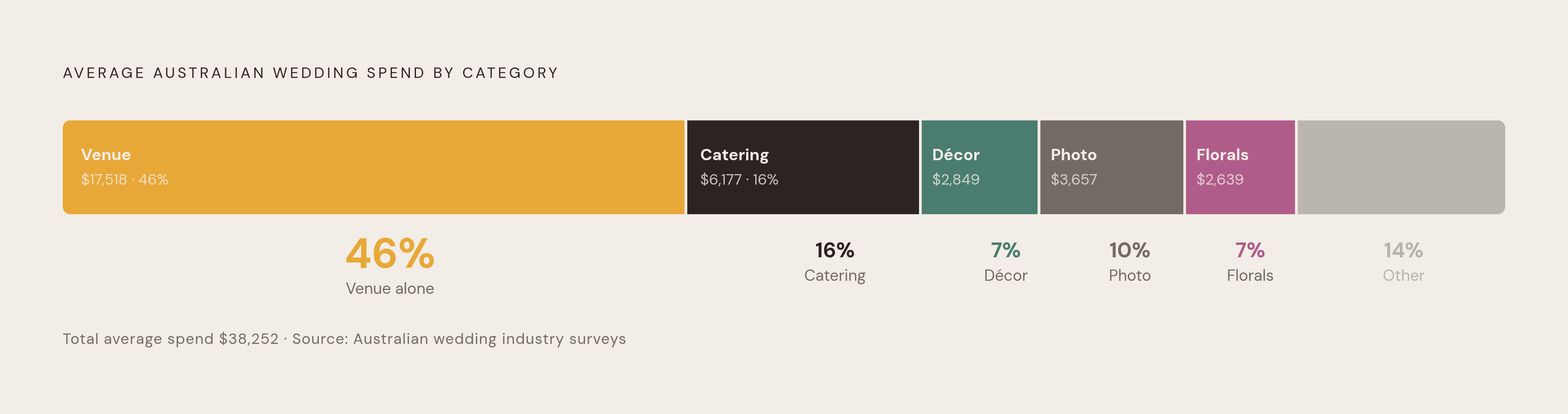
Venue eats the biggest bite of any wedding budget, and it's where the first real shock tends to land. Couples using self-serve planning software like Wedbuild, a free wedding organiser that tracks budgets, RSVPs, and seating in one place, can at least see those costs accumulate in a single view rather than across scattered spreadsheets. Industry data puts venue at around 46% of total spend, with a national average cost of $17,518. In Sydney, venue hire alone runs $5,000 to $25,000, with most couples landing near $12,500 for the venue on its own. Adding catering for 100 guests brings the total to $28,000 to $35,000. Harbourside venues push minimum spends to $10,000 to $30,000 before a single flower gets ordered.
Photography hides similar variation behind a flat national number. The national average sits at $3,657, but Sydney photographers typically quote $5,500 to $8,500 for mid-tier coverage, and Melbourne runs $5,000 to $8,000 for comparable work. Anyone budgeting off the national average is planning for a number that doesn't match their own city. That mismatch alone can wipe out a contingency fund before wedding season even starts.
Florals and styling get squeezed into one line more often than they should be. Flowers alone average $2,639. Decorations and styling, a separate cost entirely, average $2,849. Couples who budget only for "flowers" are missing nearly half the real spend in that category before a... Flowers alone average $2,639. Decorations and styling, a separate cost entirely, average $2,849. Couples who budget only for "flowers" are missing nearly half the real spend in that category before a single quote comes in.
2026 adds a cost older research never had to account for. Rising fuel costs don't stay with fuel companies. Photographer travel surcharges, florist delivery fees, and catering transport costs rise as a result. A couple pricing their wedding off 2024 quotes is planning against numbers that no longer exist.
None of these increases appear in an initial quote. They appear later, as line items nobody flagged at the start. That's where the real problem begins, and it has less to do with money than with how that money gets written down.
How quotes are structured to be incomparable
Venue and catering pricing in Australia comes in two formats that don't talk to each other, and most couples don't realize it until they're holding two quotes side by side that refuse to line up. Some venues price per head and fold food, drinks, and hire into one number. Others charge for the room separately from the food. Industry figures put standalone catering at $6,177 nationally, and $7,782 in NSW, but those figures aren't meant to be added on top of a venue quote. They come from a different billing structure.
Most venues charge $170 to $220 per head for food and drink. Once venue hire gets folded in, total per-guest cost typically runs $180 to $300. A couple holding one all-inclusive quote next to one itemized quote isn't comparing two prices. They're comparing two different pricing philosophies, and the only way through it is to unpack what each one actually includes, line by line.
The real damage rarely comes from the big numbers. It comes from the small ones that never make the first page of a quote: setup fees, pack-down charges, travel surcharges, public holiday levies, minimum bar spends, staffing minimums. WeddingNSW's analysis flags these as the charges that quietly turn a "final" quote into a starting point.
A quote, a signed contract, a deposit, and a final payment mark four separate states of commitment, not four versions of the same fact. Treating them as interchangeable is how a budget ends up looking accurate while sitting months out of date.
A fair comparison needs matching hours, matching quantities, matching staffing, matching setup and delivery terms, and matching tax treatment. Anything less is a guess wearing a comparison's clothes. The standard advice, collecting at least three quotes for categories like catering, photography, and entertainment, only works if all three are built on the same terms. Confirm what's included and what isn't before comparing any two venue quotes against each other. Mismatched terms are the default condition of Australian wedding quoting, not an occasional glitch.
Where budget trackers break down
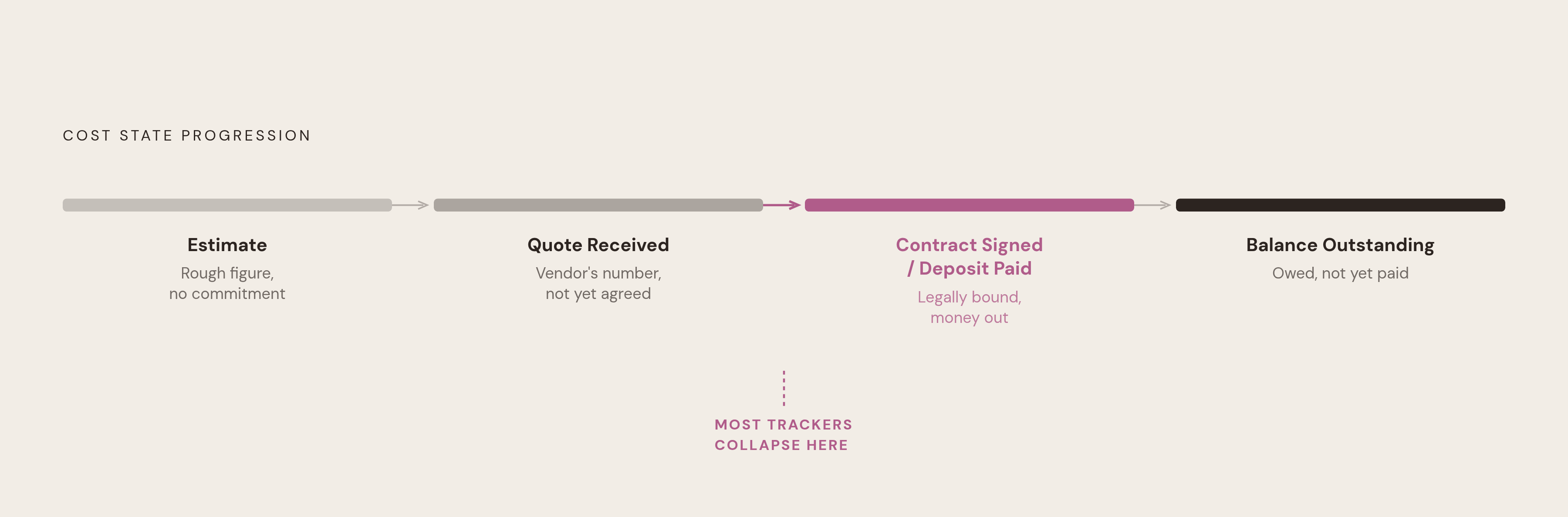
A working budget tracker needs four numbers for every line item: the estimate, the actual quoted amount, the deposit paid, and the balance still owed. It needs updating every time a quote lands, a booking gets confirmed, or a payment goes out. Most spreadsheets only capture one or two of those states. The tracker still looks current on screen while it's actually frozen at the estimate stage. It's quietly lying to whoever opens it.
The line between a quote and a commitment almost never survives contact with a standard template. In most trackers, a quote sitting unopened in an inbox looks identical to a signed contract, which looks identical to a paid invoice. All three show up as the same row with the same number next to it.
Guest count is the variable that moves everything else, and it moves more than most couples expect. Industry data shows couples plan for an average of 108 guests and end up with 85. That's a 23-person swing, and it cascades through venue tier, drink quantities, furniture hire, invitations, transport, cake size, staffing, and accommodation blocks. None of that recalculates on its own in a static spreadsheet, so the swing just sits there unaccounted for until someone notices, usually too late to matter.
Every cost in a wedding budget falls into one of two buckets: fixed (photography, celebrant, entertainment, core attire) or per-person (food, drinks, furniture, stationery, transport). Skipping that split means a guest count change that should ripple through a dozen line items instead appears as a footnote, or as no change whatsoever.
Family contribution timing deserves its own callout, because it catches so many couples off guard. Recording "$10,000 from family" as a lump sum says nothing about whether that money exists yet. If it lands in June and the florist deposit is due in March, a tracker showing a healthy balance is showing a number that doesn't match reality on the day it actually matters.
Even genuine savings get lost in translation. Sunday and midweek weddings often cut venue hire by 20 to 30%, worth $3,000 to $5,000. That saving only appears in a budget if someone manually reworks every number after the booking decision gets made, since nothing connects the choice to the number on its own.
The gap between where quotes live and where the budget lives
Vendor quotes arrive as PDFs and emails. The budget tracker lives somewhere else entirely, a spreadsheet or an app. The only thing connecting the two is a person, and that connection holds only as long as someone manually re-enters every figure, every time something changes.
Each new quote forces a decision nobody's built a system for. Does this replace the old estimate? Is it a revision of something already logged? Did the scope quietly change along the way? Without something built to answer these questions the same way every time, couples answer them differently case by case, or don't answer them.
Revised quotes cause the most damage precisely because they arrive quietly. A vendor sends an updated figure after a scope change, the email sits unread in one partner's inbox, and the tracker keeps showing the original number. Everything looks fine until an invoice arrives that doesn't match what anyone remembers agreeing to.
City-level pricing gaps make this worse before planning even starts. A couple in NSW, where the state average runs to $42,322, benchmarking against the $38,252 national figure starts around $4,000 behind their own market on day one. That gap stays invisible to a tracker built around national averages, because the tracker was never wrong about the national number, only about the number that actually applied to them.
Contingency funds get eaten by this same disconnect. Holding $3,000 to $5,000 aside as a buffer is sound practice, but a tracker that doesn't reflect real committed spend leads couples to dip into that buffer for ordinary costs without ever registering that's what just happened.
None of this comes down to a couple being careless. It's a design failure, plain and simple. Nothing in the standard planning stack connects a received quote to a budget line without a person doing it by hand, and people forget, get busy, or assume their partner already logged it.
What a connected planning setup needs to do
A setup built to close this gap needs to track all four states of every cost, estimate, quote, deposit, balance, and show each one as visibly distinct instead of folding it into a single number.
It needs to separate fixed costs from per-person costs, so a change in guest count recalculates every per-person line automatically instead of forcing someone to redo the math by hand at 11pm.
The guest list and the budget need to run as one living system, not two documents that happen to sit near each other. A guest count change should ripple into the budget without a second entry anywhere. A dietary requirement added for one guest should flow into seating, not sit in a separate document nobody opens again.
Vendor comparisons need a shared structure across every quote: identical fields covering hours, inclusions, staffing, travel, and tax treatment. Skipping that leaves the couple back to comparing PDFs with no common ground between them.
Payment timing needs its own visibility, separate from payment amount. A deposit owed in March, when a family contribution might not land until June, is a timing problem that a budget tool has to reveal in its scheduled cash-flow view, not one a couple should have to catch by memory.
Australian relevance decides whether cost estimates and vendor suggestions match what a couple will actually encounter. AUD pricing, state-level cost benchmarks, and Australian vendor categories aren't a bonus feature bolted on top. Without them, a tool is just guessing at a market it was never built for.
The planning checklist and the budget need to be one system, not two. Booking a vendor should close a checklist item and open a payment-tracking row in the same motion, not require the couple to update both separately and hope they both remember.
Stationery typically runs 2 to 3% of total spend and gets underestimated more often than almost any other category. Tied to the invitation planning tool directly, it turns from a surprise line into a decision made with the rest of the budget in view, anchored to real numbers instead of a guess.
How the main Australian planning tools handle the quote-to-budget flow
Analysis from revel.cam and invyt.app found no single app on the market handles every part of this well. Couples who plan smoothly tend to run a small, deliberate stack of tools rather than bet on one platform to do everything, and that's the honest starting point for anyone shopping for software right now.
Ivory Lane is described in that comparison as the only Australian wedding planning app built with AI-powered budget forecasting, positioned specifically to replace the wedding spreadsheet rather than digitize it. It covers budget tracking, guest list management, vendor coordination, timeline planning, and checklists, free to use with a one-off payment to unlock full functionality. It's also newer, with a smaller user base than more established players, no native mobile app yet (one is reportedly coming later in 2026), and no vendor directory of its own.
Vendor discovery in Australia still runs largely through platforms with broad national coverage across local suppliers. Their free planning tools, checklists, basic budget calculators, guest lists, seating charts, work best as a starting point for finding vendors. Those platforms are commonly funded by supplier subscriptions and lead-generation fees, so "featured" results reflect paid placement, not necessarily the best fit for a given couple's budget.
Some guest-experience platforms offer genuinely free tools, wedding websites, RSVP management, digital invites, photo sharing, but leave budgeting and vendor management as an afterthought. They pair well with a dedicated budget tool. They don't replace one.
Overseas-built platforms bring polish but carry assumptions that don't survive the trip across the ocean to a different market: seating tools capped at a small guest count on the free tier, registries that need a foreign bank account, vendor directories built around the UK or US market. Australian vendor coverage on these platforms thins out fast outside Sydney and Melbourne, and budget defaults calibrated for another country's price levels can quietly mislead a couple pricing an Australian wedding.
The practical workflow that closes the gap between quotes and budget
Split every cost into fixed or per-person before a single quote comes in. This is the foundation everything else sits on, because every per-person line needs to be tied to a guest count that the whole budget recalculates from the moment that number moves.
For each vendor category, collect at least three quotes using one consistent comparison template: same hours, same inclusions, same staffing levels, same tax treatment. A quote that doesn't spell these out clearly isn't ready to be compared to anything, no matter how final it looks on the page.
Log every quote into the tracker the moment it arrives, not after a decision gets made about it. A quote sitting unread in an inbox is a budget that's already wrong, whether anyone's opened the email or not.
Track the state of each quote explicitly: estimate, quote received, contract signed, deposit paid, balance outstanding. Treat every move from one state to the next as a budget update in its own right, not an afterthought to log later.
Review the full budget every time the guest count shifts. A change from an expected 108 guests down to an actual 85, the exact swing industry data shows as typical, runs through every per-person line in the budget. It deserves attention the first time the number moves, not after the invoices start arriving and the damage is already done.
Sources
- Best Wedding Planning Apps in 2026: What to Use and Skip — Revel
- Best Wedding Planning Apps for 2026 (Honest Roundup)
- paperlust.co
- weddingnsw.com.au
- tovstudiophoto.com
- How to Build a Wedding Budget in Australia That Reflects Your Real Life
- How Much Does a Wedding Cost in Australia in 2026?
- Wedding Statistics Australia 2026 - Ever After Weddings