All-in-One Wedding Platform Tradeoffs for Tech-Averse Couples
Manual data entry across disconnected tools costs couples time when they can least afford it.

A couple sits down on a Sunday night to update the guest list. Twenty minutes later, they're still copying three new RSVPs from an online form into a spreadsheet, checking that spreadsheet against the seating chart from last week, and wondering whether the dietary note from a relative's email made it anywhere. Neither partner finds this hard because they don't understand the apps. They find it hard because they've become the thing connecting the apps, and no one signed up to be a translator between four separate systems that were never built to speak to each other.
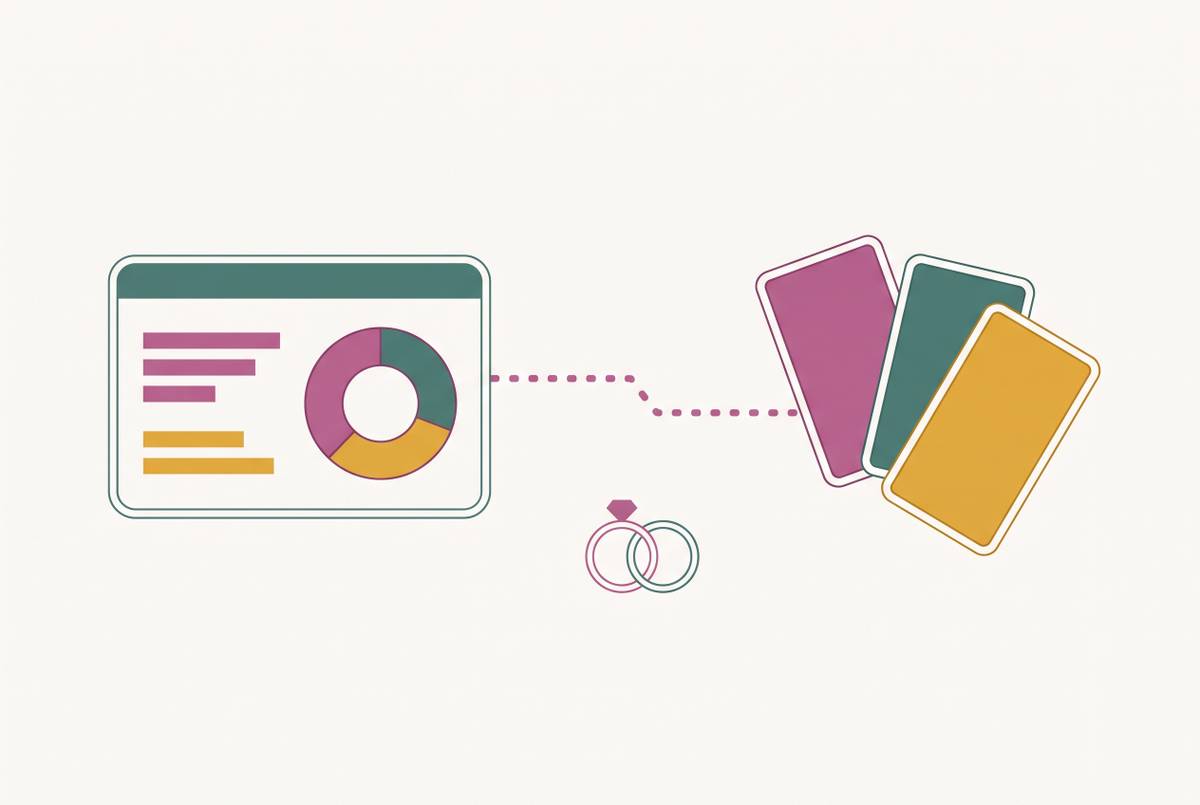
That's the real cost for couples who call themselves tech-averse. Revel's 2026 guide names the pattern directly: couples struggle when two or three tools are trying to do the same job, each holding a slightly different version of the truth. A spreadsheet for budget, a free website for RSVPs, a notes app for the seating chart. It feels safe because every piece is familiar, but familiarity doesn't stop the manual work of copying guest names from a form into a chart, then recopying dietary flags into another document before it goes to the caterer. The tools aren't failing. The workflow around them is the problem, and a tech-averse instinct toward simple, separate tools is what builds that workflow.
The three breaks in the planning chain that cost the most when tools are disconnected
Three points in the planning process do most of the damage when the tools don't talk to each other, and all three circle the same thing: guest data.
The first break sits in the chain running from RSVP to dietary need to seating. When RSVPs live in one tool, meal choices in another, and dietary flags somewhere else entirely, the final headcount, the catering guarantee, and the seating plan can't move together. Someone has to sit down and reconcile all three by hand, usually in the final weeks, when there's the least time to catch a mistake.
The second break happens earlier, at the point of collection. A lot of guest list tools gather dietary information at the household level: "the Johnsons will have chicken." That line is useless to a kitchen when one Johnson is vegan and another carries a shellfish allergy. A tool that doesn't force dietary data to be collected per person, not per household, is building a problem that won't show up during planning. It shows up at the reception, on a plate, in front of a guest who can't eat what's been placed in front of them.
The third break happens at the very end, when all of this is supposed to become one document for the caterer. A kitchen doesn't work from a summary count of "12 vegetarian, 3 gluten-free." It needs a CSV with each guest's name next to their dietary category and any allergy note attached. That's the file a disconnected stack almost never produces cleanly, because by the time a couple reaches this step, the data has already passed through three or four hands and lost precision at every stage.
Where the "all-in-one" promise breaks
All-in-one" covers a wide range of what's actually happening behind the interface, and a tech-averse couple gets caught out in the gap between those versions. A platform can bundle a guest list, a budget tracker, and a seating chart under one login and still leave a couple doing all the re-entry themselves.
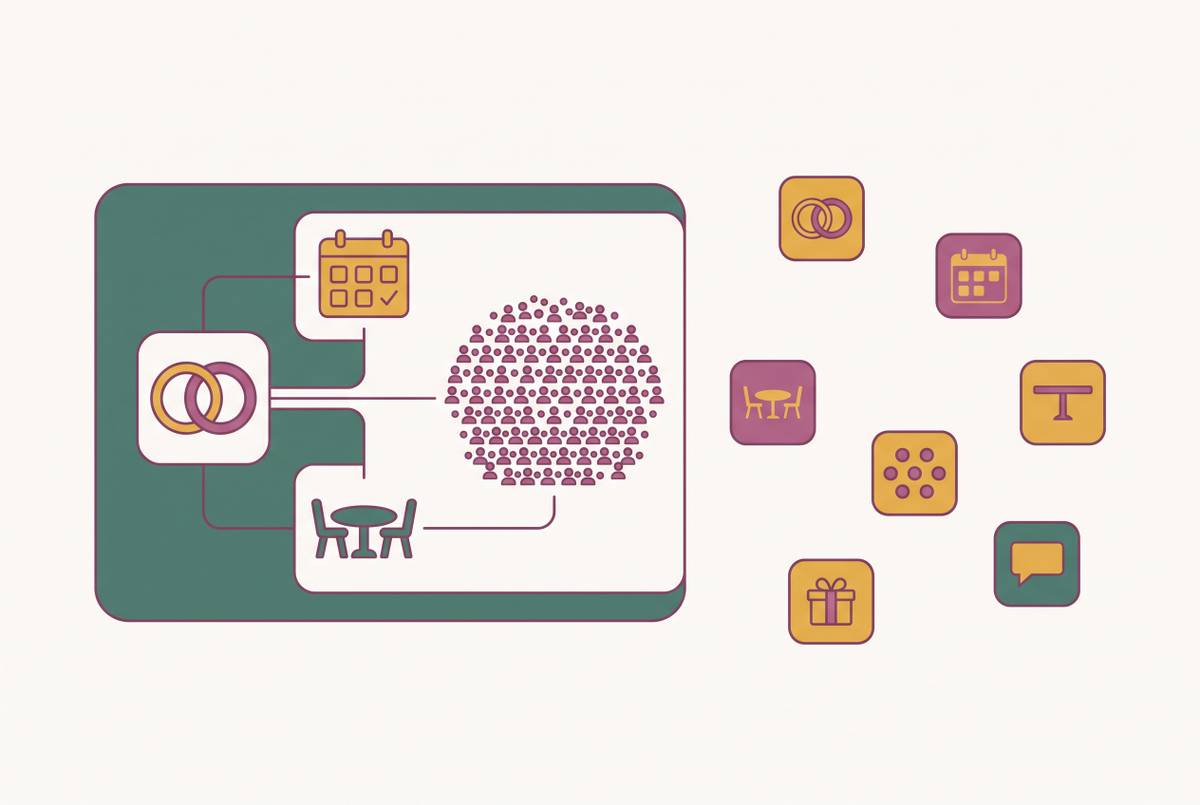
Real integration looks specific: an RSVP updates the guest list automatically, the guest list feeds the seating chart, and the seating chart carries the dietary flag through to the table-card print. One entry, no retyping, no separate export at the end. That's a different product from one where the guest list, budget, and seating chart simply share a logo and a login screen while the couple still copies numbers between screens by hand. The second version is still fragmented. It's just fragmented with better branding.
One fair objection stands against buying into any all-in-one platform. Revel's guide makes the point directly: no single platform wins every category, so stitching together the best tool for each specific job can outperform a mediocre all-in-one. That's a reasonable way to plan a wedding, and nothing about it is wrong for a couple willing to manage the handoffs between tools themselves.
The actual mistake is splitting the guest list and the budget across platforms that don't share data, because once those two things live apart, nothing stays in sync and the couple ends up back in the role of manual translator between systems. A couple can use a separate tool for photos or for vendor discovery and lose nothing, as long as the guest data and the money stay in one place that updates itself.
For a tech-averse couple specifically, there's a second trap layered on top: platforms that hold back the features needed most at the most stressful point in planning. Seating charts, guest messaging, and dietary exports often sit behind a paywall that a couple only discovers weeks before the wedding, at exactly the moment they have the least patience to go shopping for a new tool.
How Australian couples' budgets make planning-tool decisions higher stakes
Australian weddings cost enough that a planning tool saving even one budget blowout or one catering mistake is worth real scrutiny before the couple commits to it. Emu Money and Pocketwell's cost guides put the national average in the high tens of thousands of dollars, with Sydney and Melbourne running well above that figure and Brisbane, Perth, and Adelaide closer to or below it.
Most couples spend past their original budget by a meaningful margin before the wedding is done. A tool built to forecast where a category is heading and flag an overrun before it happens is doing something fundamentally different from a tracker that only logs what's already been spent. One gives a couple a chance to adjust course. The other tells them, after the fact, how far off course they already are. At the dollar figures Australian weddings run at, that distinction is worth real money, not a convenience.
Where US-built platforms fail Australian couples before planning starts
Several platforms that rank well in global roundups are structured in ways that create friction for Australian couples no workaround fixes.
Currency is the most visible version of this. AUD pricing and Australian vendor cost benchmarks are the data a budget tool actually runs on. A platform trained on US price points will hand an Australian couple category allocations that are simply wrong from the first day of planning, because the underlying assumptions about what a venue, a caterer, or a florist costs don't match the market the couple is actually buying in.
Vendor directories carry a quieter version of the same problem. The feature exists, the search box is right there, but it returns nothing useful once a couple looks outside Sydney or Melbourne. A platform noted in Ivory Lane's 2026 comparison, built in the UK, illustrates the pattern well: strong free planning tools, but budget defaults and timelines calibrated for the UK market. Couples using it have to adjust those defaults by hand, which puts them straight back into the manual reconciliation work the tool was supposed to remove.
The Australian platforms worth evaluating seriously
A small number of platforms are worth serious evaluation for Australian couples who want their planning data to stay connected instead of scattered across logins, and each comes with a tradeoff to understand before committing to it.
For vendor discovery specifically, finding and shortlisting Australian suppliers with genuine reviews, a vendor-directory-first platform is the right place to start. Ivory Lane's comparison is direct about this: that category of platform is strongest for finding vendors, with a claimed majority reach across Australian wedding suppliers, but weaker once the couple moves into actual organizing. Its planning tools tend to stay basic, and its budget tracker is usually a simple running list rather than a tool that forecasts where spending is heading. That makes it worth pairing with a separate planning tool built for the organizing itself, rather than expecting one platform to carry both jobs well.
What a free tier should cover
For a tech-averse couple, what matters is where the paywall sits relative to the planning calendar. A free tier that runs out right at seating-chart time, with the wedding weeks away, causes more stress than a modest one-off payment that unlocks everything from the start.
A reasonable free tier should cover the planning foundations: the guest list, the checklist, a wedding website with basic RSVP collection, and a budget overview. Those are the tools a couple needs from the engagement through to roughly three months before the wedding, and they shouldn't require payment to access.
What justifies paying is the set of features that matter most once planning pressure peaks: a seating chart connected to the live guest list, dietary-aware table management, a caterer-ready data export, and day-of coordination tools. These are the features a couple needs exactly when they have the least bandwidth to learn something new or switch platforms.
The most consequential gap in a lot of free tiers has nothing to do with features and everything to do with access. When only one partner has edit permissions, that partner becomes the default planner by default, and the other partner is reduced to approving decisions after the fact. That's not shared ownership of the planning process, and it quietly adds coordination work on top of everything else the couple is managing. Ivory Lane's 2026 product page, which offers its full toolset for a one-off A$99, names this directly as a failure mode in competitors' free tiers. Set against a wedding that costs tens of thousands of dollars on average, a one-off payment that heads off a single budget overrun or a single catering mistake on the day pays for itself several times over.
The seating and dietary coordination sequence that most planning tools get wrong
Seating and dietary coordination is where every failure mode described above lands at once, because it's the one task that depends on every other piece of guest data being correct and current at the same time.
A fragmented stack handles this sequence as a series of exports. The RSVP tool produces a guest count. The dietary form, if one exists separately, produces a list of preferences that may or may not be tied to individual names. The seating chart, built in a third tool or a spreadsheet, gets updated by hand whenever someone remembers to check the other two. By the time the caterer needs a final file, someone is cross-referencing three documents to build a fourth, under the kind of deadline pressure that makes transcription errors likely.
A connected platform handles the same sequence as one continuous update. A guest RSVPs, and that entry updates the guest list directly. The guest list carries the per-person dietary flag, not a household guess, into the seating chart. The seating chart, once finalized, produces the table-card print and the caterer export from the same underlying data, with no re-keying between any of those steps. A kitchen receiving a name tied to an allergy note is not the same as a kitchen receiving a headcount that hides exactly the information it needs to keep every guest safe at the table.
Sources
- Best Wedding Planning Apps in Australia 2026 (Free & Paid)
- Best Wedding Planning Apps in Australia (2026): Honest Comparison
- Best Wedding Planning Software for Australia (2026)
- Best Wedding Planning Apps in 2026: What to Use and Skip — Revel
- How Much Does a Wedding Cost in Australia in 2026?
- Average Wedding Cost in Australia 2026