When a Spreadsheet Is Genuinely Adequate for Wedding Planning
Small weddings with settled plans and few vendors can genuinely work in a spreadsheet.

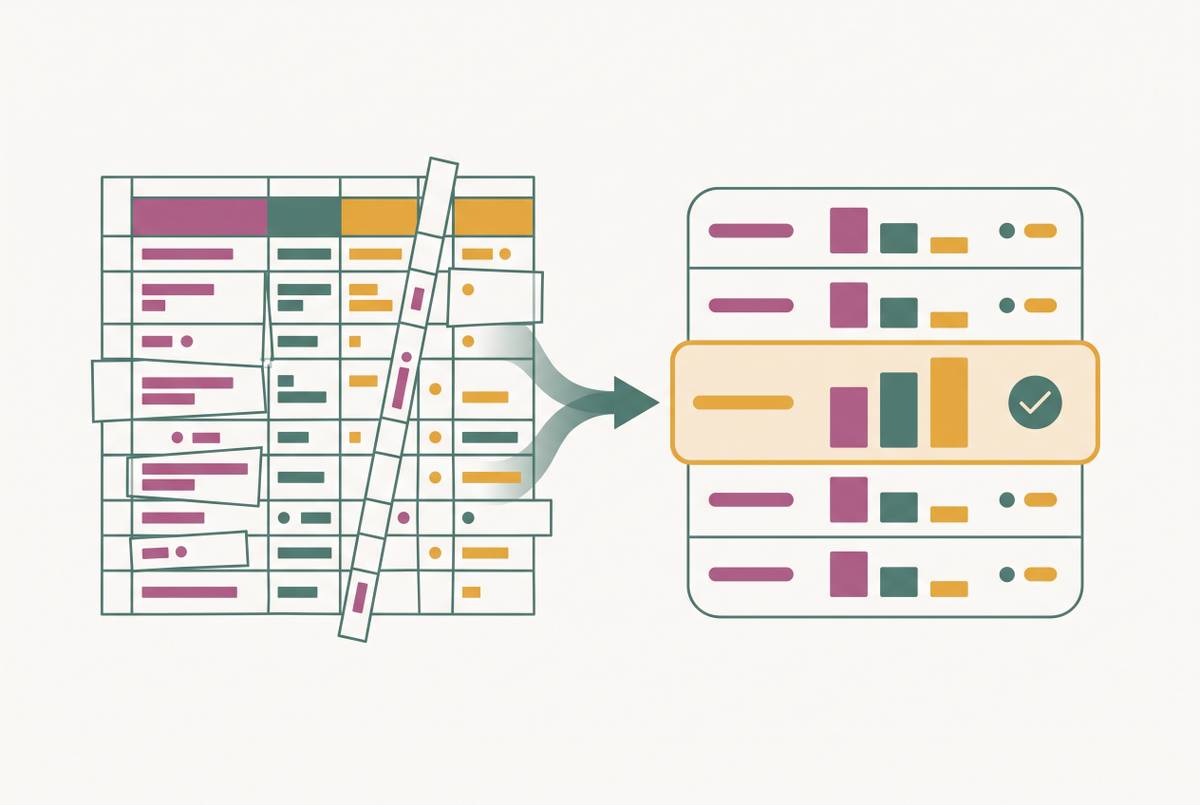
A spreadsheet can be genuinely adequate for wedding planning, but only within a narrow set of conditions. It works when the guest list is settled, suppliers are few, and one or two organised people keep the file current. The deciding factor is whether your wedding needs separate pieces of information to stay connected as plans change.
Why the spreadsheet question deserves a precise answer rather than a reflexive one
Defending or dismissing spreadsheets in principle answers the wrong question. A couple planning a small wedding where little will change has a different job from a couple juggling changing RSVPs, several payment schedules and dietary needs at each table. The same tool can be adequate for the first job and unreliable for the second. A useful assessment therefore starts with the work the tool must do.
A total may be calculated correctly from inputs that no longer describe the wedding. Even with neat headings and clever formulas, a sheet needs numbers that match what the couple has now decided. Finding that boundary means looking first at the financial stakes, then at the conditions that keep manual tracking manageable.
What makes Australian wedding costs uniquely unforgiving of planning errors
Australian wedding costs are high enough that a planning error can have a real financial effect. National averages sit well above what a typical household expects, while nearly a quarter of couples end up spending significantly more than they originally planned. Those figures show why the budget needs to reflect what has actually been booked, including charges that do not appear in the headline price.
Location changes that starting point. New South Wales has the highest state average, with Sydney metro figures at the upper end of that range. Queensland, South Australia and Tasmania are cheaper on average, with South Australia and Tasmania at the lower end of state averages. The gap between the cheapest and most expensive capital cities is large enough to undermine a budget built around another location. Moving interstate or choosing a destination venue can therefore change what the whole plan is based on.
Within that plan, the number of guests has the biggest effect on cost. With per-head pricing, adding or removing a guest can change the cost of catering, venue size, stationery, transport and possibly accommodation. An RSVP change is therefore not just an edit to a list of names. Where the budget depends on that count, the relevant estimates need to change with it.
Quotes introduce another source of error because their headline amounts do not always cover the same things. Vendor quotes frequently exclude GST, service fees, cake-cutting charges, vendor meals, overtime penalties and travel surcharges. The venue may also charge for ceremony amplification, chair cover hire, public liability insurance and corkage. A meal clause can contractually require couples to feed their photographer, DJ and planner. Even before those extras, a florist quoting an amount and a venue quoting the same amount plus GST are charging different prices, so adding them up as though they were the same gives the wrong total.
Where spreadsheets genuinely hold — the narrow, honest conditions
A spreadsheet works when the amount of manual upkeep is small and someone reliably does it. When one person plans alone or with one highly organised co-planner, it is clear who does what. There are fewer opportunities for shared-edit confusion, conflicting versions or uncertainty about which information is current. Under those conditions, maintaining a single file is a defensible way to plan.
With fewer than a handful of vendors, straightforward quotes and simple payment arrangements, there is a limited amount of information to reconcile. The person maintaining the sheet can account for each supplier’s price and what it includes. A spreadsheet does not need to be replaced merely because the wedding involves money or bookings.
A settled guest list strengthens that case considerably. If the list is genuinely final, it does not keep generating changes that must be carried across the budget and seating plan. At a small scale, the necessary guest information is also manageable in a sheet. The tool can hold a clear record of who is coming and where they will sit, provided that record is kept current.
The file is yours forever, is exportable, requires no account and costs nothing. There is no paywall between you and a feature you need at a stressful moment.
Spreadsheets also work well for comparing vendors, however big the wedding is. The work is to convert each quote into the same all-in number at the same guest count, then score suppliers against priorities chosen in advance. Rows, columns and calculations fit that job. Doing this before any one venue wins you over is sound practice because it gives the comparison a consistent basis. A spreadsheet can therefore remain useful for this task even when the rest of the wedding needs a different tool.
The inflection point where spreadsheet management breaks down
The turning point comes when an update in one place needs to change several other things. In a sheet whose tabs are not linked, a change to the RSVP count in one tab leaves a catering calculation elsewhere using the old number until someone fixes it. The calculation may still work perfectly. Its input is what has become wrong, and the resulting total gives no useful picture of the current commitment.
A list can adequately show who has accepted or declined. But once per-head catering costs and seating assignments depend on that count, a change to it affects them too. Every change must reach every place that relies on it.
Seating makes this manual work especially visible. At a small scale, five columns are workable, namely name, table, RSVP status, dietary need and relationship group. With more than a modest number of guests, those details are easy to store but hard to cross-reference. For a caterer who needs a PDF of dietary requirements for each table, the details recorded against names must be grouped by table so they can be used during service. Producing that view from a basic sheet takes significant manual work, and mismatches left unresolved can become a coordination problem on the morning of the wedding.
Supplier payments expose a different limit. Several vendors may each require a deposit, a mid-planning payment and a final balance, creating a timeline that someone has to watch. A spreadsheet can represent those commitments, but it cannot monitor the schedule or alert the couple. Spreadsheet management fails when reliable planning depends on someone repeatedly synchronising information and remembering to act on it.
What couples at the inflection point actually need from a planning tool
Connected data addresses that problem. When the guest list changes, the tool should automatically recalculate the catering estimate if the price is per head. The seating chart should take dietary requirements straight from RSVPs so no one has to enter them again. These connections address the actual failure by removing the gap between a change and the information that depends on it.
Supplier management needs the same clarity. Quotes should be compared using the same guest count and all-in prices, with vendors scored against what matters most to the couple before they fall in love with a venue. Payment schedules should then be visible in the same place as the budget tracker. Seeing deposits and final balances together makes the timing of those commitments part of the financial plan.
When a tool defaults to AUD pricing, Australian vendor categories, seasons and legal requirements, it removes ways for errors to slip in that US-built platforms can introduce. The Notice of Intended Marriage is a concrete example of a date-dependent requirement. It must be lodged with the celebrant at least one month before the ceremony. That belongs in a checklist tied to the wedding date.
Cost still matters when comparing that system with a free spreadsheet. A platform that is free to start, with couples paying only for features they actually need, removes the need for an upfront purchase simply to begin. Even then, owning the spreadsheet and having no paywalls are reasons to weigh it against the platform. Some tasks can also stay outside the platform. There are standalone tools just for seating, but using one adds another set of data to keep up to date, with no link to the guest list or RSVP tab. Tools can be assessed by whether they remove manual reconciliation or merely relocate it.
A self-assessment couples can use before choosing their planning tool
The decision can be reduced to five factual checks about the wedding. These are not tests of whether you are good with technology. The checks show whether there will be few enough tasks and changes to keep track of by hand. To make the answers consistent, each check below is phrased so that “yes” supports using a spreadsheet.
The first check is whether your guest count is under 75 and almost certain to stay there. A yes means a spreadsheet can handle seating and RSVP tracking at that size. A no, or uncertainty about the eventual count, puts you outside that condition.
For the second check, look at whether your vendor list has settled at a small number of suppliers whose quotes and payment terms are simple. If it has, manual tracking is manageable. If those bookings involve staggered payments, variable GST treatment or complex package comparisons, a structured tool earns its keep. The number of suppliers matters, but so does the work hidden inside each booking.
The third check is whether the guest list is final. This is separate from its size because a small list can still generate repeated changes. A moving list is the most reliable trigger for spreadsheet failure when its updates must be copied across several tabs.
The fourth check is whether you are planning alone or with one highly organised co-planner who will maintain the sheet consistently. If more people are involved, version conflicts and stale information become an operational problem. This check is about how the file will be maintained throughout planning.
The fifth check is whether you can manage without dietary requirements flowing automatically into the seating chart or a per-table dietary summary for the caterer. A yes means the tracking is still simple enough for a sheet to handle. If you need those connected outputs, this task alone exceeds what a spreadsheet handles cleanly.
A yes to all five puts your wedding inside the narrow band where a spreadsheet is genuinely adequate. Use one without guilt. A no or an uncertain answer to any check places you at or beyond the point where a connected tool is the better fit. Beyond that boundary, staying with a spreadsheet brings extra admin and the risk of relying on wrong information precisely when the numbers need to be right.