Australian Wedding App Features That US Platforms Do Not Offer
Australian wedding apps handle local costs, vendors, and guest data that US platforms simply cannot.
Australian couples searching for a wedding planning app run into a simple problem: the market they find is American. US-built platforms have bigger budgets, and they have stronger search rankings and more name recognition, so they end up on top of every search result. Almost every roundup a newly engaged couple in Sydney or Perth reads was written for an American audience, by an American outlet, about American tools.
The first impression rarely raises a flag. The interface looks clean, signup is free, and the features look like what a wedding needs: a guest list, a budget tracker, a checklist that counts down the months. Nothing about the signup screen says "this wasn't built for you."
The trouble appears once the couple actually starts using the thing. Registry features ask for a US bank account and a US address. Vendor directories come up empty for Brisbane, Adelaide, or Melbourne. Budget tools show figures in US dollars, built around a US national average that has nothing to do with what a wedding costs in Australia. By the time a couple notices, they have often already spent three months planning inside a tool that could never hold up.
The gaps are structural, not cosmetic, and cannot be patched
These platforms don't fall short because the design is bad or the checklist is too short. The failure sits deeper, in how the product is built: the legal workflows, the vendor data, the currency logic, and the way information moves between features all assume a different country. No settings menu fixes that.
Start with the legal workflow, because it's the least negotiable of the four. Australian law requires couples to lodge a Notice of Intended Marriage, known as the NoIM, at least one month and no more than 18 months before the ceremony. US platforms have no equivalent step built in. They use the word "officiant" instead of "celebrant," and the celebrant role doesn't exist anywhere in their vendor categories. Because the tool never asked, a couple planning around a US checklist can miss the single most legally important deadline in the whole process.
Currency and cost benchmarks create the second mismatch. US budget templates anchor to a US national average, a number that bears no relationship to what an Australian wedding costs. A couple in Sydney working to a budget of $42,000 to $55,000 AUD isn't just looking at the wrong currency symbol. So they plan against a cost-per-head reality, a venue market, and a supplier landscape that the US average was never built to reflect.
Vendor directories are the third gap, and they become most visible once a couple starts actually booking people. A functional US platform works because it sits on top of thousands of reviewed, bookable vendors. That infrastructure stops at the US border, with partial coverage in Canada and, in some cases, India. Open the vendor directory for an Australian city on one of these platforms; what looks like a search tool is, in practice, an empty shelf.
The fourth mismatch is the one that matters most once the wedding day actually arrives. US platforms treat guest management, RSVPs, dietary requirements, seating, and day-of logistics as separate modules that don't talk to each other. RSVPs should flow into the guest list. Dietary requirements should flow into the seating chart. The seating chart should flow to the kitchen and back out to the guests being served. On most US platforms, that chain breaks at every handoff, and the couple ends up rebuilding the connections by hand, the exact spreadsheet problem the app was supposed to remove.
What the Broken Data Chain Costs Australian Couples
That broken chain isn't a minor inconvenience to work around. At the scale of an actual Australian wedding, it has a direct cost in dollars and in moments that go wrong in front of a hundred guests.
ABIA data puts the average Australian wedding at about 91 guests. Catering in 2026 varies a fair amount per head, and a plated three-course dinner sits well above the cheaper options. If a guest's dietary requirement gets lost somewhere between the RSVP form and the kitchen, it means a real plate, cooked wrong or not cooked at all, for a guest who paid nothing but whose seat still cost the couple real money.
Most US platforms collect dietary information as free text in a comments field, rather than as a structured, categorised data point that a seating tool or a kitchen list can actually read. That means someone, usually one half of the couple, has to manually reread every RSVP comment and manually cross-reference it against a seating chart, often the morning of the wedding, with a caterer waiting on final numbers.
Cost-per-head across Australian states stays fairly consistent, so you pay around $437 to $489 per guest no matter the city. That consistency matters, because every guest whose dietary need gets missed, or who can't find their table, cost the couple a fixed sum of money for nothing. With 91 guests on average, you can't call a handful of dropped dietary requirements a rounding error. It's hundreds of dollars of catering spend that produced an awkward moment instead of a meal.
How Australian-Built Tools Are Designed Differently
Australian-built platforms start from a different premise: the dietary-RSVP-seating-kitchen-guest chain is one connected system, not five separate features bolted together. Because of that single design decision, the outcome on the actual wedding day looks different. An RSVP comes in and updates the guest list automatically. A dietary requirement gets captured as a structured field, not a comment, so the seating chart can read it directly and build place cards and kitchen lists from that same source, and nobody has to retype anything.
A second structural feature follows from the same logic: the day-of runsheet. Managing Matrimony builds this as a native tool rather than an afterthought, giving every moment of the day a time, a place, and an owner. Couples set anchors through the day and assign each moment to a person, a wedding party member, or a vendor, so they can see at a glance whether every planned moment actually has someone responsible for it. US platforms rarely offer anything built for this purpose, so couples end up improvising a version of it in a shared document instead.
AUD pricing and Australian cost benchmarks work the same way: they're a structural choice built into how the product calculates things, not a display setting toggled on for the local market. Ivory Lane's AI budget forecasting is trained on Australian city-level numbers, with Sydney set around $42,000, so the budget allocations it suggests reflect what Australian couples actually spend. That's a different exercise than converting a US average into Australian dollars at the day's exchange rate. One reflects local reality. The other reflects a number from a different country, wearing a dollar sign that just looks right.
What each Australian-built platform does well
No single Australian platform wins every category, and the right pick depends on which part of the planning chain matters most to a given couple: budget discipline, vendor booking, print and stationery, or hands-on human help.
One option runs on a one-off AUD payment rather than a subscription: free for weddings up to a modest guest count, with two paid tiers that unlock two years of access. The free tier comes with the budget planner and the seating plan already built in. The paid tiers add a wedding website and invitations, and you get a seven-day free trial. A founder who planned a wedding and ran into the same gaps this piece describes built it solo, and you can see that in the accountant-designed budget planner and the automatic sync between dietary data and seating.
Managing Matrimony was built in Sydney, founded in 2018, and it takes a different approach. It carries an Australian vendor directory of more than 3,000 active businesses, a number that puts real weight behind the word "directory" rather than leaving it empty the way US platforms do for Australian cities. It also runs an integrated design studio for printed stationery, producing welcome signs, seating charts, menus, and place cards, delivered Australia-wide. Save the dates and invitations sit as a separate feature, and the platform doesn't say printing happens locally, but no US platform operating in Australia can match this fulfilment capability.
Its most distinct feature is the option to add real human coordination on top of the software, from the same platform. Couples can choose a lighter coordination package, scale up to on-the-day coordination, or go all the way to full wedding planning, at prices that rise with the level of support. That combination, software, a genuinely populated local vendor directory, print fulfilment, and optional human coordination in one place, isn't something any US platform operating in Australia currently replicates.
How Australian Wedding Costs and Timelines Expose the Gaps
The financial scale and the scheduling pressure of an Australian wedding are what turn these structural gaps from annoying into expensive. Sydney is the top end of Australian wedding budgets, with Melbourne behind it, then Brisbane, Perth, and Adelaide at the more affordable end of the national range.
Venue hire in Sydney alone covers a wide price range in 2026, and if you add catering for a full guest list, it's typically the single largest line item in the whole wedding budget. If a tool is quietly working off the wrong currency or the wrong cost-per-head figure, it makes its biggest recommendation, the one covering the largest expense a couple will face, on numbers that were never calibrated to Sydney or any other Australian city.
Timing adds its own pressure. Australian weddings cluster around two peak seasons, spring from September to November and autumn through March and April, and the best venues and photographers get booked out 12 to 18 months ahead of those dates. A couple using a planning tool with no sense of Australian deadlines has no warning that the window for their preferred venue is closing faster than the app's generic checklist suggests.
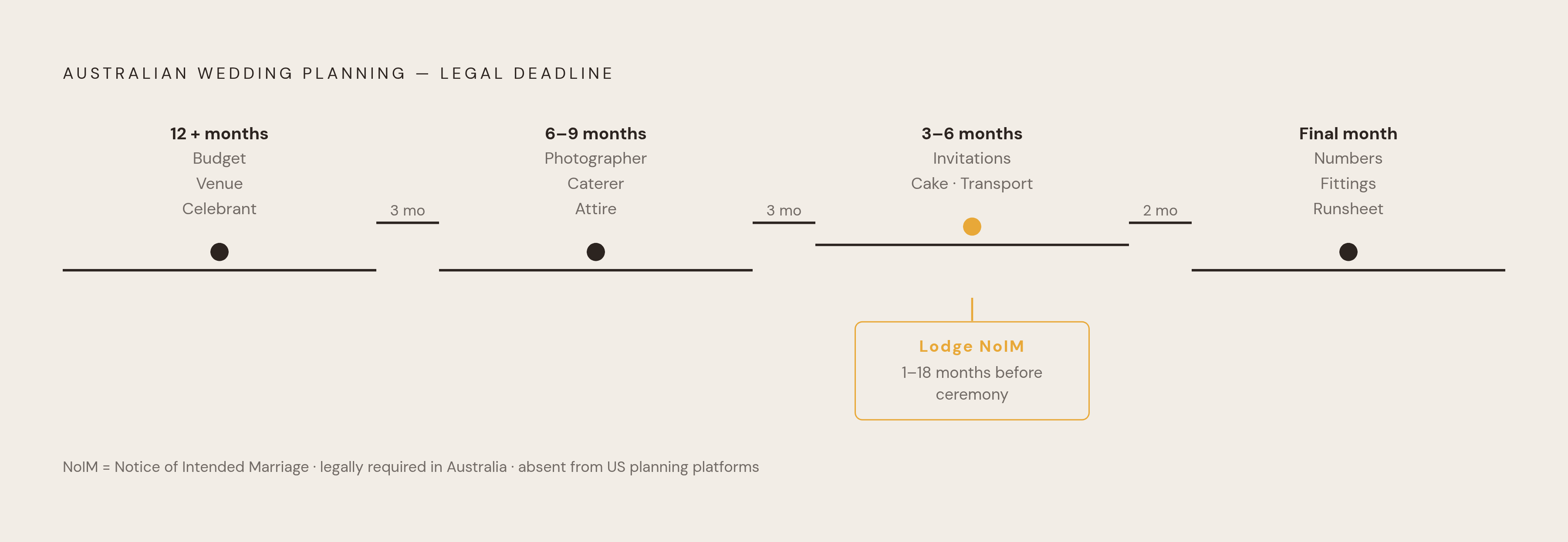
The correct sequence, as laid out in Australia's Wedding Guide checklist, runs on a clear timeline: 12 or more months out, set the budget and book the venue and celebrant. At 6 to 9 months, lock in the photographer, caterer, florist, and attire. At 3 to 6 months, sort invitations, cake, and transport, and lodge the NoIM. In the final month, confirm numbers, finish fittings, and lock the runsheet. Vendor deposit terms in Australia follow their own local pattern too: you typically pay a portion upfront, with the balance due in the weeks before the wedding. A platform that doesn't know the NoIM needs to be lodged in that 3-to-6-month window, because it was never built around Australian law in the first place, leaves the couple to catch that deadline on their own.