What Wedding Planning Apps Do With Guest Dietary and Contact Data
Wedding apps' business models determine how much your guests' contact and dietary data gets shared.
Wedding planning apps hold more than a couple’s plans. They hold guests’ contact details, relationships and dietary needs. What happens to that information depends far more on who pays the platform than on how long its feature list is. The practical choice is therefore about both privacy and getting an accurate guest list into the caterer’s hands.
Why the business model behind a wedding app matters more than its feature list
Most couples choose a planning tool by its features or price, without asking who else benefits from the information they enter. That misses the business underneath the software. A guest list may look much the same across apps, but the reason each business wants to hold it can be different. The revenue source creates the incentive, while the privacy policy describes what the platform says it may do.
The main models are vendor-subscription directories, commerce-and-registry platforms, and planning tools that put the couple first. A vendor-subscription directory earns money when vendors pay for placement and leads, so names, contact details, event dates and signs of how much couples might spend are useful to the business. A commerce-and-registry platform earns on purchases, so spending patterns and preferences matter across its services. A couple-first planning tool earns directly from the couple through a payment or upgrade, so it has no structural need to monetise guest data through third parties. That distinction provides a starting point for judging a platform alongside its terms.
What data wedding apps actually collect — and how much of it belongs to guests, not couples
The couple’s own information is only part of the record. Wedding dates, venues, total budgets, vendor preferences and spending patterns describe the event and the people paying for it. Couples choose to give those details as they plan. The guest list then extends that record to people who did not choose the software. Their participation in a wedding becomes participation in a platform selected for them.
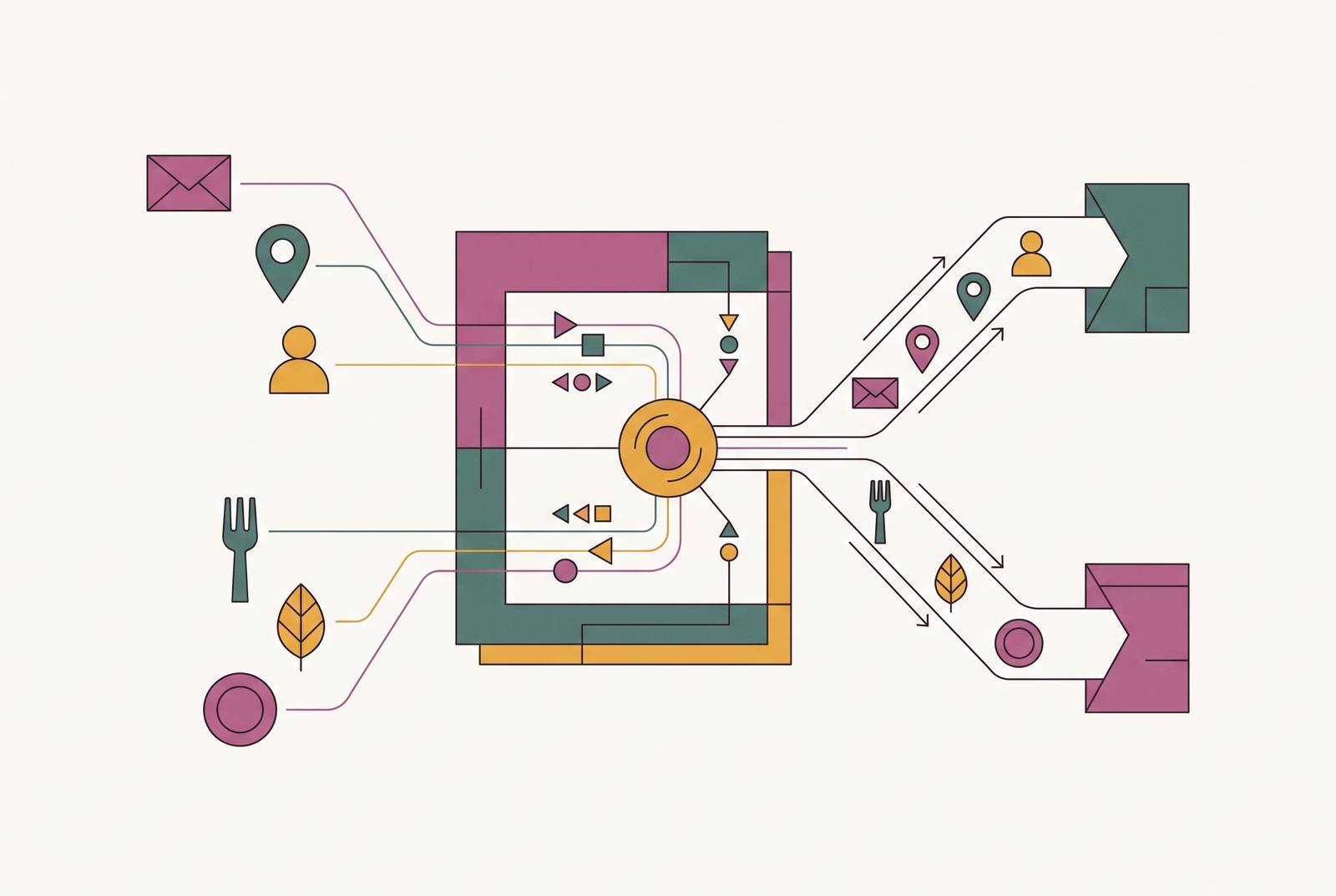
The information held on guests can include their full names, postal addresses, phone numbers, email addresses and how they know the couple. When guests RSVP, they also give their meal choices and dietary requirements, usually without seeing much of the privacy policy. Together, those fields go well beyond a simple attendance count. They describe how someone can be reached, how they know the couple and what they can eat. The fact that the couple needs this information does not settle what the platform should do with it.
Dietary details also differ in sensitivity. Vegetarian, vegan, gluten-free and dairy-free preferences are personal lifestyle information, while severe allergy flags involving nuts, seafood or gluten concern guest safety and can constitute health information under some privacy frameworks. That makes both the collection and destination of the data important. On a vendor-advertising or commerce platform, guests may have no direct relationship with the business holding their answers and no obvious route to request deletion. An RSVP answers an invitation while potentially leaving the guest uninformed about that wider relationship.
How the dietary and RSVP data layer creates a specific operational and privacy problem downstream
Collecting an answer is not the same as producing a useful handover. Caterers typically need a final headcount, each guest’s meal choice, dietary requirements, separately flagged severe allergies and children’s meals. They usually need that information one to two weeks before the wedding. At that point, an untidy notes field creates an operational problem.
Most wedding apps ask guests to give their dietary restrictions in free-text notes. A comment such as “nut allergy” or “vegan” may capture the answer, but the couple must still read and sort those comments to prepare the caterer’s list. The same field is being asked to carry both a meal preference and a safety warning. That leaves manual interpretation at the point where accuracy matters most. A missed allergy flag is not equivalent to an untidy spreadsheet.
Structured collection separates meal selection, dietary category and a binary severe-allergy flag. That turns the handover into a CSV export, saving an afternoon of copy-pasting. The distinction matters even if the platform never shares information with advertisers.
Late RSVPs add to the work because the couple also lacks answers about meals and allergies. Unless the platform shows non-responders and provides a follow-up mechanism, the couple must track them manually. Plus-ones and children must also be counted in the final total, even if they were added as comments. The full job is to capture those answers, identify who has not replied and carry the result into the seating chart and caterer count. A tool that only records responses handles part of that job.
What Australian privacy law currently requires of platforms holding guest data — and where the gaps are
Australian privacy law is changing, but the proposed protections do not help couples decide what to use today. Whether a platform falls under the Privacy Act matters, and a duty to disclose a practice can apply without giving people a right to stop it. The current framework leaves meaningful gaps after a wedding is over. Couples cannot assume that every business with a guest list has to follow the same rules. Nor does an app’s availability in Australia, by itself, explain its accountability.
The OAIC states that the statutory tort for serious invasions of privacy commenced on 10 June 2025. It covers intrusion upon seclusion and misuse of personal information. Individuals can sue directly for a serious, intentional or reckless invasion without waiting for the OAIC to act. That is a significant route to accountability, but its seriousness threshold matters. It is not a general mechanism for asking an app to remove an old guest list.
The OAIC’s APP 1 Guidelines set out a further disclosure requirement from 10 December 2026. APP entities must disclose when they use computer programs to make, or substantially and directly help make, decisions that could significantly affect an individual’s interests. The requirement includes both rule-based logic and AI. Algorithmic vendor matching or AI budget tools will therefore need assessment against the new APP 1.7 requirements where the platform is covered. This change requires transparency about consequential decisions while leaving automated tools permitted.
Australia currently has no general right to erasure comparable to GDPR Article 17. A proposed right in the 2026 exposure draft is limited to large digital platforms and has not passed. Removing the small business exemption has also been proposed as part of Tranche 2 reforms, but the exposure draft released on 31 August 2026 does not include that removal. Smaller Australian wedding platforms below the annual turnover threshold may therefore remain outside the Privacy Act framework. For couples choosing now, neither the proposed erasure right nor the proposed wider coverage guarantees a deletion path for their guests.
How three platforms with different models actually handle the same guest data
The three revenue models provide a useful comparison, but the available named-platform details support only a narrower assessment. The available details provide a partial account of where guest contact and dietary data goes, with the sharing of any particular allergy entry still requiring evidence beyond an advertising disclosure. A payment model is not proof that all guest information stays private, either. The useful contrast is between the practices actually disclosed and the incentives behind them.
MyWed Wedding Planner is available around the world on Android and iOS and has both ads and in-app purchases. MyWed’s Play Store listing says the app may share app activity, app info and performance, and device or other IDs with third parties. The listing also says it may collect personal info and financial info among other data types, that data is encrypted in transit and that deletion can be requested. Those disclosures describe a mixed revenue model with both advertising and direct purchase income. They do not identify dietary requirements as a shared data type.
MyWed’s guest list supports meal selections and RSVPs. Its free tier caps guest numbers, while premium unlocks a larger list. That makes the tool relevant to the catering workflow, but support for meal selections alone does not establish how severe allergies are separated or exported. Encryption in transit tells couples how data is kept safe as it travels, while a deletion request gives them a way to ask for it to be removed. Neither disclosure should be stretched into a broader claim about every use of guest data.
The Private Wedding App offers subscription and one-time lifetime purchase options, giving it a direct-payment relationship with couples. It also allows RSVPs to be closed when the caterer’s count is final, giving the couple operational control over when collection ends. The comparison therefore supports checking revenue, collection controls and deletion separately, rather than treating any one of them as a complete privacy verdict.
The strongest objection to avoiding free vendor-directory platforms — and why it only partly holds
Free vendor-directory platforms can provide a searchable marketplace, millions of vendor reviews and planning tools at no direct cost to the couple. For someone using a directory as a phone book and verifying vendors independently, that can be a reasonable exchange. Paying for software is not automatically better value, and a direct-payment model does not itself prove better data practices.
The trade-off is clearest when the couple supplies its own name, email address and wedding date. Those are details the couple can choose to expose with at least some visibility into what it receives in return. The problem changes when the same planning process brings in guests’ addresses, contact details and dietary requirements. Those guests did not select the platform and may not see its data-sharing arrangements.
That asymmetry is the strongest reason to separate directory usefulness from guest-data storage. A couple can accept a privacy cost for itself, but it cannot treat that as the informed choice of a hundred guests. Obtaining a free marketplace’s value may require other people’s personal information to enter the same system.
A second objection is that structured dietary collection sounds like marketing dressed up as safety. The operational test is more concrete than that. Free-text notes require manual sorting at the caterer handover regardless of who owns the app or how it earns money. Separate meal, dietary and severe-allergy fields reduce that particular source of error. Those fields help keep guests safe and save work, but they do not show how well the platform handles privacy in other ways.
What to ask before entering guest data into any planning platform
Start by asking who pays for the platform. If vendors pay, ask what information is needed to serve them and whether guest contact details are used to generate leads. If couples pay, ask whether the charge is a subscription, a one-off payment or an optional upgrade from a free tier. Those arrangements offer clues to the business model and create different incentives, all of which require examination alongside the data terms.
Next, ask where the information is hosted and which jurisdiction applies. An Australian-hosted platform operating under the Privacy Act offers a different accountability structure from an offshore platform with no Australian presence. Then ask what happens to guest information after the wedding and whether there is a clear deletion process. Without one, and without a general Australian right to erasure, the data may persist indefinitely. The answer needs to address deletion of the stored guest record separately from closing RSVPs.
Finally, ask whether guests give dietary requirements in structured fields or free-text notes, and whether those answers go into the seating chart without being entered again. Those details predict whether the final handover is a clean export or another round of manual work where allergy flags can be missed. The aim is not to prescribe one platform for every couple, but to make the choice before other people’s information is committed. Couples who ask these questions early are better placed to reach the caterer handover with a clean, accurate list and without unknowingly enrolling their guests in a vendor marketing database.