One-Time Payment vs Subscription Wedding Planning Software
The payment model determines whether features get locked right when couples need them most.
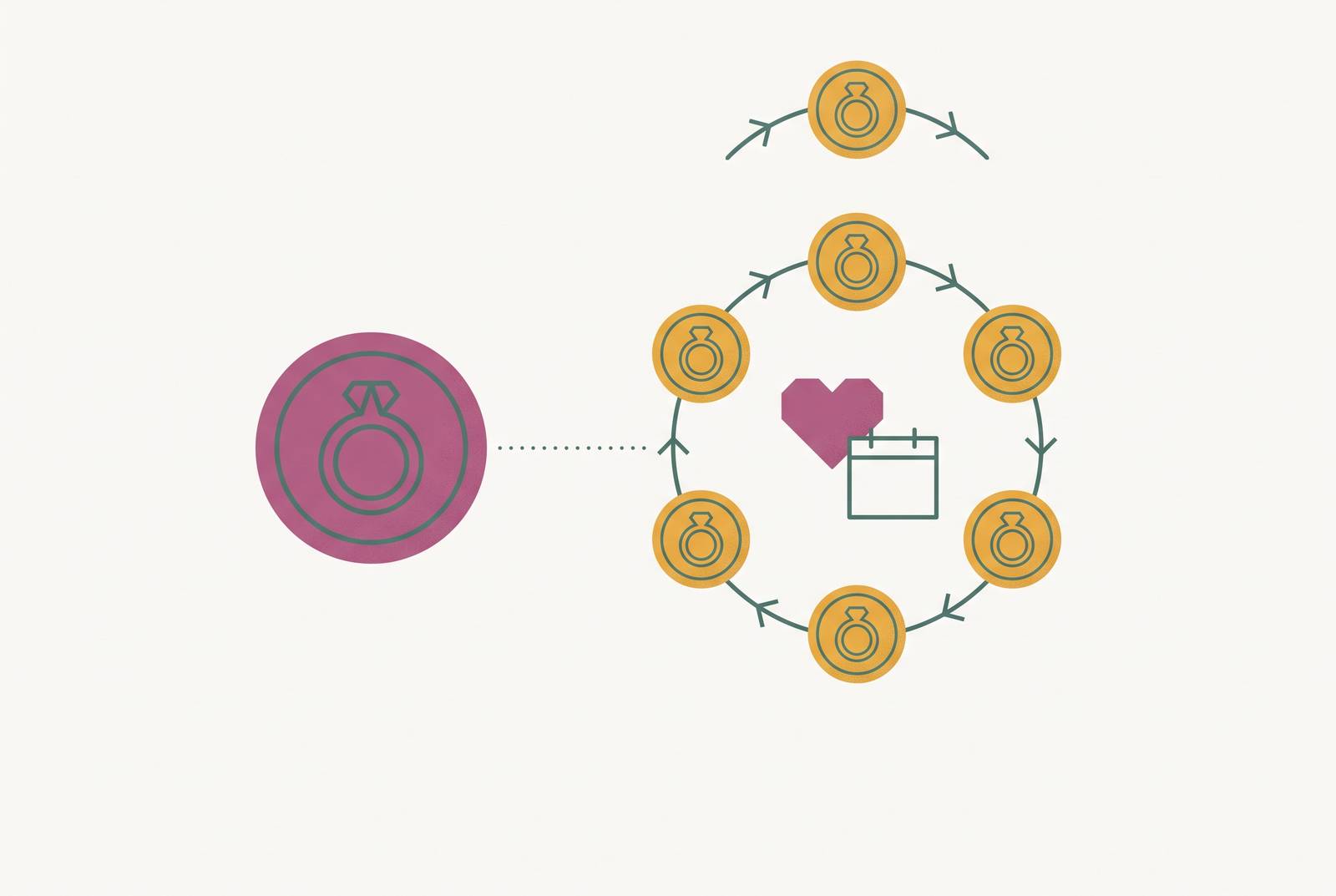
A couple downloads a wedding planning app that looks free, builds out their guest list over a few weekends, and then hits a wall a month before the wedding: the seating chart, the one tool they actually need right now, sits behind a monthly plan they didn't sign up for. A couple hitting that wall is the predictable result of a payment model that was built to do exactly that.
Most couples compare wedding planning software the way they'd compare any app: scan the feature list, check the price, pick the one with the most checkmarks. The payment model, subscription, one-time fee, or free-with-ads, is the actual architecture behind the product. A subscription platform makes money by keeping a couple paying for as many months as possible. A one-time-payment platform makes money by delivering enough value in a single purchase that the couple feels it was worth it. A free-with-ads platform makes money from vendors paying for placement. The vendors, not the couple, are the customer.
These differences aren't abstract. Those differences appear in which features get locked, which information the app pushes in front of the couple first, and what happens to the account once the wedding is over. A wedding runs on a fixed timeline: engagement to wedding day, usually twelve to eighteen months, then done. That breaks the standard software logic of maximizing "customer lifetime value," because there's no long-term customer to retain. How a platform handles that mismatch, whether it tries to extract recurring revenue anyway or prices itself around the actual planning window, determines what a couple gets for their money.
How subscription pricing shapes what gets built and gated
Subscription software makes rational business decisions that don't always serve the couple using it. If the goal is to keep someone paying monthly, the smart move is to hold back the features people need most urgently for last, so they renew right when the stakes are highest. Seating charts are a common example: a feature that's often locked behind a paid tier specifically because couples tend to build it close to the wedding, when walking away isn't really an option. The same goes for advanced dietary tracking and full guest list exports. These are the tools a couple needs in the final stretch, and that's precisely when a paywall has the most leverage.
A second, separate conflict appears on platforms funded by vendor advertising rather than subscriptions. These platforms often give away checklists, budget calculators, and guest list tools at no cost because the business model makes its money elsewhere. Those free tools exist to pull couples into a vendor marketplace, where photographers, caterers, and venues pay for placement. The "recommended vendor" lists on these platforms reflect who paid for visibility, not who does the best work. The planning tools are the bait. The vendor directory is the product, and the couple's attention and data are what's being sold.
None of this makes subscription or ad-funded platforms dishonest. It means their incentives point somewhere other than straight at the couple's needs, and worth understanding that before signing up for either.
What a free plan must cover to be useful
A free tier earns the word "free" only if it covers the real skeleton of wedding planning, not just a sample of it. For an Australian couple, that skeleton is four things: guest list management, online RSVPs with dietary fields, a wedding checklist, and a budget tracker. These are the tools needed before a single dollar goes to a vendor, and a free plan that leaves one of them out or cripples it is a page designed to collect an email address and start a sales funnel.
A wedding website on a free subdomain is a fair addition to a free tier, and most platforms that offer one deliver real value at no cost. Seating charts are a more defensible place to draw the line between free and paid, because a usable seating chart needs real data: a confirmed guest count and actual RSVP dietary responses, both of which only exist close to the wedding date. Gating a feature that depends on data the couple doesn't have yet, months in, is a different decision than gating something they need from day one.
Wedbuild illustrates one way to handle that balance. It offers a 50-guest list free for as long as a couple needs it, with no credit card required, alongside a seven-day trial of Pro tools including the seating chart and budget planner. That structure makes the upgrade path visible from the start rather than springing a paywall on a couple two weeks before the wedding.
The honest test of a free plan comes down to one connection: does dietary information collected at RSVP time flow automatically into the seating chart? If a platform makes a couple manually copy dietary flags from a spreadsheet of RSVP responses into a separate seating tool, the free plan hasn't saved them work. It's handed them a data entry job at the exact moment they have the least time to do it.
Why one-time payment suits a fixed-duration event
A wedding has a start date and an end date, and that fixed window is the strongest argument for paying once instead of monthly. Couples aren't ongoing software users the way someone subscribing to a project management tool for their job is. They need a tool hard for twelve to eighteen months, then they're done with it. A one-time payment prices the software against the value of that entire stretch. A monthly subscription prices it against a commitment the couple has to remember to cancel, and across twelve to eighteen months, that adds up to a real cost for a product they'll never open again after the reception.
The timing risk of monthly billing is worse than the cost. If a couple falls behind on payments or simply forgets to renew, a subscription model can cut off access to their own data right when it matters most: final headcount, dietary breakdowns, seating assignments, the exact information they need in the week before the wedding. A one-time payment removes that risk. Once it's paid, the data and the tools stay available.
Paying once also changes who the platform is actually serving. A platform funded by the couple's one-time payment, rather than by vendors buying placement, has one customer: the couple. That removes the conflict of interest baked into ad-funded recommendation engines, because there's no vendor paying to be ranked higher. Platforms built this way, Wedbuild among them, align the product with the couple's actual timeline: built to deliver full value across the whole engagement-to-wedding arc, not to keep collecting fees after the wedding is over and the tool has become digital clutter on someone's phone.
The strongest case against one-time payment is a real risk: a platform with no recurring revenue has less ongoing money to keep servers running and ship updates than a subscription business does. But it cuts both ways. Subscription platforms shut down, get acquired, or pivot their business model too, and a couple's data is just as exposed either way. The question that matters is whether the platform lets a couple export their guest list, RSVPs, and seating chart in a usable format, so the data survives even if the platform doesn't, since neither pricing model can promise to last forever.
The connected-data problem that payment model alone does not solve
Payment model answers who the platform is working for. But it doesn't answer whether the tool actually works end to end, and every platform has to pass that test regardless of how it charges. The test is simple to state: do RSVP responses flow automatically into the guest list, does dietary information flow from there into the seating chart, and does the seating chart flow back out to guests and the kitchen on the wedding day? Most platforms, whether they charge monthly, once, or nothing, break that chain somewhere.
The hardest link is dietary data reaching the seating chart. Venues need meal counts by type, vegetarian, gluten-free, allergies, well ahead of the wedding, so that information has to be captured at RSVP time and land directly in the seating tool without anyone retyping it. A lot of platforms collect the data cleanly at the RSVP stage and then stop. The dietary responses sit in one part of the system, the seating chart lives in another, and reconciling the two becomes a manual job squeezed into the final weeks of planning. That's the point where a free plan, a subscription, and a one-time purchase can all fail the same way: a couple ends up cross-referencing a guest list against a seating chart by hand, on a kitchen table, with a wedding ten days out.
Wedbuild's full chain runs RSVP to guest list to seating chart to dietary-printed table cards, finishing with a QR-code "Find My Seat" tool guests scan on the day. That's a concrete picture of what an actually connected system looks like: a guest fills out dietary information once, and it travels automatically all the way to the printed table card and the QR code at the door, with no one re-entering it by hand.
Not every couple needs an all-in-one system, and that's where a tool like SeatPlan.io fits. It's free with no signup required and supports CSV import, a legitimate option for a couple who has already solved guest list management and RSVPs elsewhere and just needs a standalone seating chart. Its QR-code delivery of seat assignments sits behind a paid Collaborate plan or above, which is a reasonable trade for a single-purpose tool rather than a mark against it.
The real cost of a disconnected system is standing in a hallway on the wedding morning, half-dressed, manually matching dietary flags against place cards because two tools that should talk to each other never did.
How the platforms available to Australian couples stack up
Australian couples face one more filter beyond payment model and data connection: whether a platform was actually built for the Australian market, with AUD pricing, Australian vendor information, and planning timelines that match Australian seasons and legal requirements, rather than a US product with a currency converter bolted on.
Wedbuild is built in Australia and uses a one-time payment model: free to start, with a single optional payment that unlocks the full feature set and no subscription to cancel afterward. The free tier covers a 50-guest list for as long as a couple needs it, with no credit card required, and a seven-day Pro trial that includes the seating chart and budget planner. The full chain runs from RSVP through guest list, seating chart, dietary-printed table cards, and a QR-code "Find My Seat" tool for guests on the day. The feature set includes a drag-and-drop website builder with templates, multi-event RSVPs with structured dietary tracking, a visual seating designer with a floor plan editor, a budget planner with invoice and payment tracking, a vendor comparison tool, a digital invitation designer with email campaigns and open and click tracking, and bulk guest import from Excel or CSV. It also includes AI-powered budget forecasting based on guest count, city, and target budget, real-time collaboration between partners with assignable tasks and a shared decisions log, and AUD pricing with support for couples in several other countries. It suits couples who want one connected system, built in Australia, priced honestly, without a subscription to remember to cancel, and who want genuine budget forecasting and shared planning without needing a built-in vendor directory.
Managing Matrimony is also built in Australia, with tiered AUD pricing, an Australian vendor directory, and stationery delivery across the country. It suits couples who specifically want a vendor directory bundled with their planning tools, with the same trade-off that applies to any directory-funded platform: the directory is the core business, so vendor recommendations carry the same conflict of interest as other ad-funded models.
Invyt is a focused RSVP and guest management tool rather than a full planner. It handles multi-event RSVPs with separate guest lists per event on one dashboard, built-in WhatsApp and SMS sharing, QR codes for printed invitations, and bilingual invitations for diaspora families. It suits weddings with multiple events and different guest lists for each, or couples who specifically need WhatsApp or SMS delivery and bilingual invitations.
Kaiplan is a US-based platform built on a one-time fee, designed for couples planning without a professional. It works offline and carries no vendor ad model, which suits couples who want offline access and a single payment and don't mind sourcing an Australian-relevant vendor directory on their own.
Aisle Planner is professional wedding planner software, built for planners managing multiple clients and events rather than for couples planning their own wedding. It suits couples already working with a planner who uses it, not couples planning solo.
Matching the right payment model to the couple's actual planning situation
Three questions settle which payment model fits: how long the planning period runs, how many features the couple will realistically use, and whether they're planning the wedding themselves or working through a professional planner. Once those three are answered, the right model is usually obvious.
Free-with-ads platforms are a reasonable place to start for vendor discovery, especially for couples who want Australian vendor reviews and real directory depth. They work best paired with a separate planning tool whose incentives sit with the couple, since the ad-funded platform's recommendations are shaped by who's paying for placement, not by what's actually best for the wedding.
Subscription platforms make sense for couples who want the widest possible feature set and don't mind paying monthly, as long as they ask one question before signing up: what happens to the data and tools if they stop paying a month before the wedding?
One-time payment fits the actual shape of a wedding: a bounded project with a start date and an end date, not an open-ended subscription. The automatic connection between RSVP dietary data and the seating chart says a lot about which philosophy a platform follows. A subscription model has a reason to hold that connection back, since gating the seating chart drives upgrades right when couples are most likely to pay. A one-time-payment tool like Wedbuild builds that connection in from the start, because the couple's data staying intact through the wedding day is the only thing the product is for.