Wedding Planning Apps That Send Unwanted Vendor Emails After Signup
Broad signup consent lets platforms turn couples into profitable vendor leads.

Most wedding planning apps that flood a couple's inbox with florist pitches and photographer brochures within hours of signup are not glitching. They are doing precisely what their business model was built to do. The real product on these platforms is the couple's contact details and planning stage, packaged and sold to vendors who pay to reach them.
Look at how the dominant platforms actually make money. Nearly all of them are vendor directories first and planning tools second. Revenue comes from vendor subscriptions and advertising, not from the couples using the checklist or guest list features. So when a couple creates an account, they are not simply starting a wedding planner. They are entering a lead-generation funnel, where their relationship status, location, and wedding date become data points with a price attached.
The vendor side of this arrangement tells the same story from the other direction. Vendors who pay to appear in these directories say they get flooded with low-quality, copy-paste messages mass-sent to every supplier on the list. Nobody wins here. Couples get pitched by businesses they never asked to hear from, and the vendors funding the whole system get buried in generic outreach that rarely turns into real bookings. A business model built on volume rather than fit degrades the experience for everyone paying into it or caught inside it.
How signup consent becomes a marketing licence
The mechanism behind the flood of vendor emails is the privacy policy a couple agrees to the moment they tick a signup box, a few lines of text that almost nobody reads. That clause does more legal work than its length suggests, converting a one-time registration into standing permission for ongoing marketing contact.
Manage My Wedding's policy, cited in the research behind this piece, offers a clear example of the language at work. It permits the platform to use or disclose personal information for "targeted and behavioural advertisement, marketing communications, and informing users about services, upcoming promotions and events." That single sentence covers almost anything a platform might want to send: vendor offers, affiliate promotions, event announcements, with no stated limit on how often or for how long.
Australian email marketing law does draw real boundaries. The Spam Act requires consent, requires the sender to identify itself, and requires a working unsubscribe link that has to stay functional for a set minimum period. Platforms build signup consent broad enough to cover years of future marketing, so technical compliance and genuine informed agreement end up being two very different things.
Two regulators split the oversight here. The Australian Communications and Media Authority enforces the Spam Act. The Office of the Australian Information Commissioner oversees Privacy Act compliance, for businesses above a set annual turnover threshold and for certain other organisations regardless of size.
Consent is personal to each partner, not shared across a couple. If each partner has not expressly agreed to receive marketing from a specific business, sending the same promotional email to a joint account or a shared contact list may breach both the Spam Act and the Privacy Act. A platform that treats a couple as a single marketing target, rather than two people who each need to consent, is standing on shakier legal ground than its privacy policy implies.
Privacy Act reforms and the consent loophole
The legal ground under this entire business model is shifting. Proposed reforms to the Privacy Act would require that collecting and using personal data be objectively fair and reasonable, a higher standard than simply securing a user's click of "agree" at some point. That standard, if it becomes law, aims directly at the kind of broad signup consent that currently justifies years of vendor marketing from a single registration.
The core change is a proposed new Australian Privacy Principle 3, built around a "fair and reasonable in the circumstances" test. Instead of asking only whether consent was technically given, the test would ask whether a person would reasonably expect the platform to use their data that way, what harm the practice risks, whether the use is proportionate to its purpose, and factors including transparency, data minimisation, genuine choice, and, where relevant, a child's best interests. That is a materially higher bar than a pre-ticked checkbox buried in a signup form.
Submissions on the Privacy Act Tranche 2 reforms closed on 18 September 2026, which places this squarely in active, near-term regulatory territory rather than some distant policy conversation. Platforms sitting on years of customer data gathered under looser consent standards would need real time and real resources to refresh that consent to meet a fair-and-reasonable test, especially if they carry a large existing user base.
The direction of travel points toward the EU's GDPR model, where consent by itself has never been treated as a complete answer to a privacy compliance question. Other factors, like proportionality and necessity, carry independent legal weight there.
None of this makes what platforms are doing today illegal. Current law permits broad signup consent, and the reforms remain proposed rather than enacted. But couples weighing which planning app to trust with their contact details are choosing a vendor at a moment when the regulatory ground under that vendor's entire marketing model is already moving.
The compounded disadvantage for Australian couples
Australian couples face a compounded version of this problem when they use platforms built overseas. They get the unsolicited vendor marketing, and the planning tools they are left with are calibrated for a country that is not Australia.
The mismatch makes the inbox noise worse, not just more frequent. A couple planning a wedding in Melbourne or Brisbane might receive gift registry promotions or vendor suggestions built around suppliers from another country, none of which has any bearing on their actual wedding.
Costs vary sharply by Australian city, and a tool calibrated overseas has no way to reflect that. New South Wales has the highest wedding costs in the country, Victoria follows, and Tasmania comes in considerably cheaper than both. A Sydney wedding's combined venue and catering costs run well above what the same elements cost in Melbourne or Brisbane. A budget tool built around US or UK price points simply cannot surface numbers like these, because the entire pricing model it runs on comes from somewhere else.
That mismatch lands on top of a budget problem couples already face regardless of what app they use. Couples typically start planning with a budget that falls well short of what they end up spending, overshooting their original number by around 23%. If a planning tool spends its energy generating vendor marketing instead of surfacing accurate, city-specific cost data, it widens a gap that was already working against the couple before they opened the app.
One UK-origin platform evaluated in a recent comparison illustrates the pattern directly. Its Australian vendor directory is thin outside Sydney and Melbourne, and its budget defaults and planning timelines are built around UK conventions, forcing Australian couples to manually adjust numbers and schedules that should have been right from the start.
The planning features a vendor-directory model starves
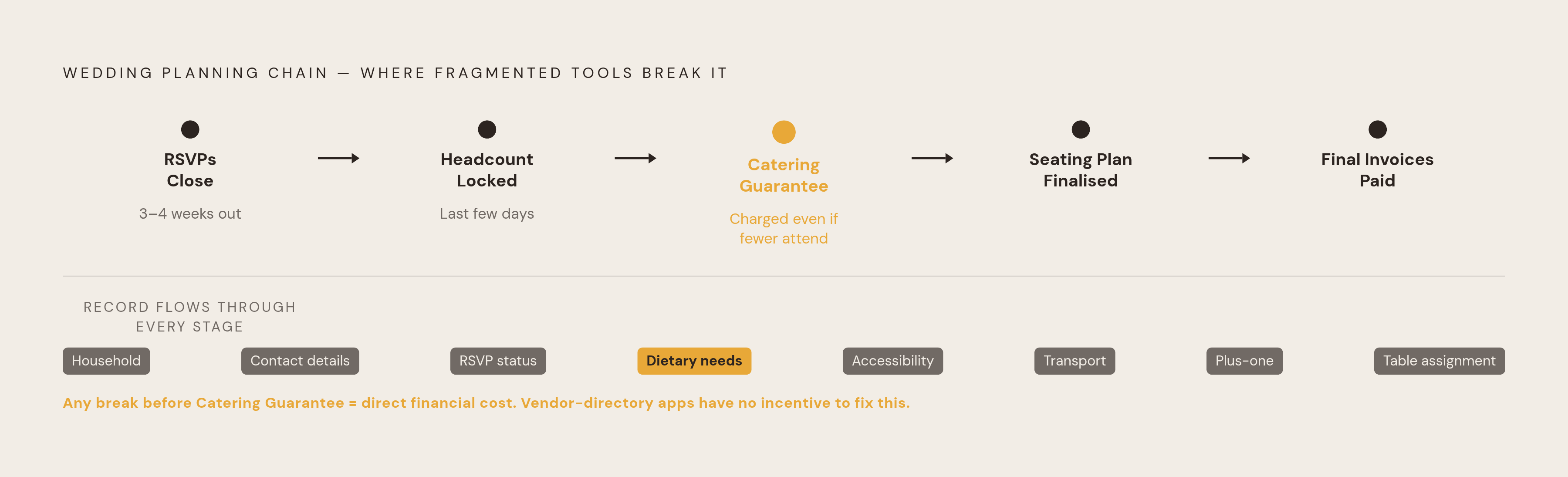
A platform built to maximise vendor exposure has little reason to put money into the planning infrastructure that actually gets a couple through their final weeks before the wedding. The feature that suffers most under this model is the chain connecting RSVPs, dietary requirements, and seating, which is exactly the chain that determines whether the wedding day runs smoothly.
The timeline here is unforgiving. Formal invitations go out six to eight weeks before the wedding. RSVPs close three to four weeks out. The final headcount, usually locked in during the last few days before the event, drives the catering guarantee, the seating plan, and the final invoices a couple has to pay. Most caterers charge for the guaranteed headcount even when fewer guests actually show up, so a break anywhere in that chain carries a direct cost.
A guest record that actually holds up under this pressure needs to track household, contact details, RSVP status, dietary requirements, accessibility requirements, transport needs, plus-one details, and table assignment, all in one place. That single record then has to feed invitations, the seating plan, catering counts, and shuttle bookings without anyone re-entering the same information four times.
Fragmented tools break this chain constantly. If a couple uses one app for RSVPs, a separate spreadsheet for seating, and a third tool for tracking dietary needs, they end up doing manual reconciliation between all three, bringing back the spreadsheet work they thought they'd escaped by downloading an app. Revel's 2026 guide names this failure mode directly: the common trap is having "two or three tools are trying to do the same job," like a checklist app, a spreadsheet checklist, and a planner's checklist PDF all running in parallel for the same wedding.
Connected planning tools and vendor-directory platforms pull in opposite directions. A platform earning its revenue from vendor subscriptions has no financial reason to spend its engineering budget perfecting a seating chart or a dietary-tracking system that no advertiser pays for. The tension between those two priorities is structural, not accidental, and it sets up a clear standard for evaluating the tools couples actually have to choose between.
Advertiser bias in AI features on directory-led platforms
AI-assisted planning tools built on top of a vendor directory inherit that directory's bias. If the data feeding an AI recommendation engine comes from a pool of paying advertisers, the recommendations it produces will favour those advertisers, whether or not that favouritism is stated anywhere in the product.
General-purpose AI carries a separate, more basic risk: it invents facts. Documented testing shows ChatGPT will "confidently invent Australian vendor names, pricing and venues that do not exist." Nothing about that output signals uncertainty. The tool states a nonexistent venue with the same confidence it would use for a real one, which makes general-purpose AI unsuitable for local pricing questions or specific vendor recommendations.
This matters because AI-assisted wedding planning is no longer a fringe habit. Roughly 87% of couples planning a 2026 wedding say they use at least one AI tool somewhere in the process. With adoption running that high, errors in AI output are not a hypothetical edge case. They are a live risk for the large majority of couples currently planning a wedding.
AI still does real, useful work in planning when the task is bounded and doesn't depend on local vendor knowledge: drafting a vendor inquiry email, producing a first pass at wedding vows, or flagging an unusual clause buried in a contract. None of that work requires the AI to know which caterer operates in a specific local area or what a particular reception venue actually charges.
The meaningful distinction is between AI trained on real budget data tied to a specific city and guest count, and AI that is really just a chat interface sitting on top of a vendor marketplace's advertiser inventory. The first is answering a factual question using real numbers. The second is generating marketing copy dressed up as a recommendation. Telling those two apart is the same skill a couple needs to read a privacy policy carefully: knowing what's actually driving the output in front of them.
A comparison of the main planning tools for Australian couples avoiding the directory model
Once you see the business model, the legal backdrop, and the planning-chain risks clearly, comparing tools gets easy. The platforms worth considering for Australian couples share one structural trait: no vendor directory, so there is no commercial reason to sell a couple's data to advertisers.
One option runs on a genuinely connected system: an RSVP update feeds straight into the guest list, which updates the seating chart, which prints table cards complete with dietary legends. A QR-code "Find My Seat" feature helps guests find their table on the day itself. It's free for weddings up to 50 guests, with the budget planner and seating chart included in paid plans that come with a seven-day free trial. This fits couples who want the RSVP-dietary-seating chain to work automatically, without being enrolled in a vendor marketing funnel the moment they sign up.
Ivory Lane is built in Australia, with a Melbourne-based team, and its AI budget forecasting runs on actual Australian pricing benchmarks across major cities including Sydney, Melbourne, and Adelaide. You get partner collaboration with assignable tasks, a shared decisions log, and real-time edit syncing, plus a vendor payment tracker with reminders and a dietary-aware guest list. By Ivory Lane's own comparison, it's a newer platform with a smaller user base, it has no native mobile app yet (a dedicated app is planned for later in 2026), and its vendor marketplace is not launching until late 2026. It suits couples who want AI-assisted budget forecasting built on real Australian numbers and genuine partner collaboration, and who don't mind being early adopters of a platform still filling out its feature set.
Planning.Wedding is completely free, with no upsells, and runs in the browser only, with no mobile app. It covers the checklist, budget, guest list, seating chart, day itinerary, and a basic wedding website. Its premium tier is a single one-time payment per wedding rather than a subscription, adding PDF and Excel export, full seating chart tools, and storage for a large library of guest photos. The platform also offers premium features at no cost to anyone planning a wedding during a difficult financial situation, available simply by emailing and asking. With no vendor directory built into the product, there's no structural reason for the platform to generate marketing email. If you want a free, distraction-free planning tool and aren't looking to discover vendors through the same app, this suits you.
Notion isn't a wedding-specific tool at all, but its strength is data ownership: everything built inside it is exportable, with no lock-in to the platform. Notion AI can summarise vendor emails, draft replies, and generate checklists. The tradeoff is real setup time, since building a usable wedding workspace from scratch takes many hours before any actual planning happens, and third-party templates vary widely in quality, with most failing to handle budget rollups correctly. Notion's AI carries no wedding-industry knowledge, no Australian pricing benchmarks, and no RSVP or seating integration, so it has no built-in sense of wedding planning norms or timelines. This option suits couples who already use Notion for work and want to build wedding planning on top of a workspace they already trust.