Wedding Website Guest Data Collection and Third-Party Sharing
Couples choose platforms but guests become unwitting data subjects with limited control.
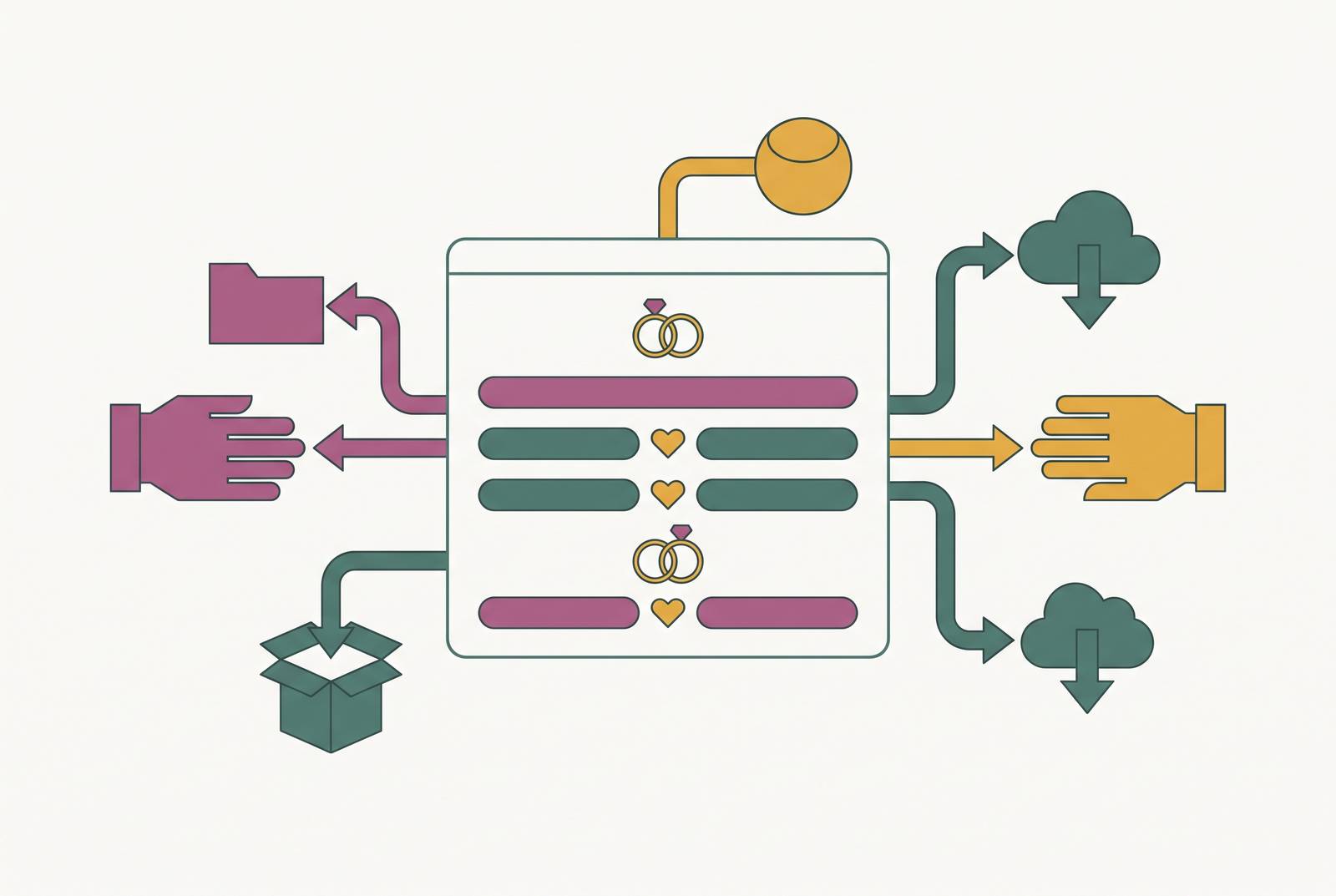
Wedding websites collect more than replies to an invitation. They gather personal guest information that can pass through hosting companies, messaging services and wedding vendors, then remain stored after the event. The strongest protection starts with platform choice, but it also depends on limiting vendor access and asking for deletion when the wedding is over.
What wedding websites actually collect when a guest submits an RSVP
An RSVP form can collect a guest’s name, attendance status, dietary requirements, song requests and plus-one details. Those answers sit beside the couple’s account information, including event dates, the venue and a guest list with contact addresses. Across a mid-sized wedding, this becomes a rich dataset of attendance decisions, meal choices, relationships and logistical preferences. It is useful for planning precisely because it connects people with their needs. That same connection makes it personal.
The dietary and allergy field is the most sensitive part of that record. It can turn an ordinary attendance form into a health-adjacent dataset. Yet the visible fields are not the whole collection. WedSpace’s privacy policy says it collects IP addresses, browser types and usage patterns automatically. Guestlist’s privacy policy also says it collects device type, operating system, app usage and log data, which includes the pages guests visit and timestamps. Guests therefore leave technical information as well as the answers they knowingly submit.
Why guests are data subjects without a voice in the choice of platform
The couple chooses the platform, but the guest becomes part of its records. Uploading a guest list can put someone’s personal information into a service they did not choose, agree to use or even know exists. What looks like a planning preference is also a data decision made for other people. The guest has little say at the moment that decision is made. That imbalance is why platform choice deserves more thought than whether the invitation page looks good.
The Wedding Shop’s privacy policy puts responsibility on the person supplying the details. It states, “You are responsible for ensuring that your guests are happy to be contacted in this way and that you have a lawful basis for sharing their data with us.” Guestlist’s privacy policy takes a similar approach, telling a host who supplies contact information that “you are the data controller” while it acts as a service provider. These statements assign responsibility to the person uploading guest details. What they must do depends on which privacy law applies.
Guests can, in principle, request access or deletion, but the route is not always obvious. The Wedding Shop’s policy directs them to contact the platform. WedSpace’s policy directs them to the couple first, or to its support team. A guest who never chose the service may not know where to begin.
How data moves from the RSVP form to third-party infrastructure
The data chain starts with the form, but it does not end with the wedding platform. Hosting providers supply the infrastructure, analytics providers process data on how people use the service, and messaging providers help send messages. These are separate roles, even when the guest sees only one website. Third-party sharing can mean giving another company access to perform part of the service.
WedSpace’s privacy policy names AWS and Google Analytics as third-party providers. Guestlist’s privacy policy says it uses hosting and analytics providers but does not name them. Access limited to what a provider needs for its work narrows the scope, but it does not remove that provider from the chain. The platform’s own promises are therefore only part of the picture. The providers of its infrastructure have their own terms and policies.
Messaging adds another link. Weddingkart’s privacy policy says guest WhatsApp messages pass through the WhatsApp Business API, which Meta Platforms, Inc. runs, and that this sends guests’ contact information across borders. Its promise not to sell guest phone numbers does not change which infrastructure delivers the message. Receiving a wedding reminder also does not, on its own, show that a guest has agreed to that transfer. Delivery and marketing are different uses, and both matter when tracing where data goes.
The vendor handoff — where guest dietary data is most at risk
The most sensitive vendor handoff happens when dietary requirements leave the platform for the caterer. A seating chart can combine a guest’s name, table number, RSVP status, dietary needs and group or relationship. When the full row is shared, those details travel together. The document is convenient because it gathers the planning information in one place. That convenience becomes a privacy problem when the recipient needs only part of it.
The minimum standard is to share only what each vendor needs. The caterer needs dietary restrictions, while the DJ does not. The calligrapher needs names and table numbers, but not phone numbers or email addresses. Yet many couples send a full export to every vendor because filtered exports are rarely the default. The workflow makes oversharing easier than sending a limited record, even for careful couples.
Data retention: how long guest information stays on a platform after the wedding
The wedding date is not usually a deletion deadline. On most platforms, guest information remains until someone asks for removal, and some retain it indefinitely by default. The Wedding Shop’s privacy policy is explicit. It states, “We do not delete guest data automatically, but will remove it if you or your guests ask us to.” The burden therefore falls on people who may have no reason to return to the service.
Guestlist’s privacy policy keeps data “as long as your account is active, as needed to provide the Service, as required to comply with legal obligations”. It also allows limited retention after deletion for compliance purposes. Before signing up, couples should ask whether deletion happens after a defined period or requires a request. They should also ask whether it covers third-party service providers or only the platform’s own servers.
What Australian privacy law currently requires of wedding platforms — and where the gaps are
The Privacy Act 1988 governs how personal information is collected, used, stored and disclosed in Australia. Its 13 Australian Privacy Principles apply to private sector organisations whose annual turnover is above a certain amount, but many small or new wedding app operators may fall below it. That creates a gap between the sensitivity of the information and the protections that apply to its holder. Size matters to the law even when it makes no difference to the guest.
The Act classifies health information, including allergy and dietary restriction data, as sensitive information with stronger protections than ordinary personal data. But those protections apply only if the platform is covered by the Australian Privacy Principles. The Office of the Australian Information Commissioner states that the statutory tort for serious invasions of privacy commenced on 10 June 2025 under Schedule 2 of the Privacy Act. That change gives individuals a direct court route for serious invasions alongside the option of a complaint to the regulator. Some privacy concerns may still fall short of that serious-invasion standard.
The Australian Government released the draft Privacy Amendment (Personal Data Protection) Bill 2026 on 31 August 2026 and set 18 September 2026 as the last day for submissions. The Bill proposes a broader, technology-neutral definition of personal information, with examples including pseudonyms or identifiers and location data. Those examples do not explicitly name IP addresses, device IDs or cookie identifiers, so their wider coverage remains an interpretive question. The Bill also proposes consent that is voluntary, informed, current, specific and unambiguous, prohibiting pre-ticked boxes, bundled consents and interfaces that make refusal unreasonably difficult. Separately, the Office of the Australian Information Commissioner’s May 2026 Issues Paper states that disclosure obligations for substantially automated decision-making commence on 10 December 2026. Couples choosing AI-assisted planning or guest-management tools should keep these changes in mind, without having to make their choice a legal exercise.
How platform business models predict data behaviour
How the platform makes money offers the quickest useful starting point. Advertising and vendor marketplaces create incentives to share data that direct user payments do not. A marketplace earns revenue when couples book vendors through it, so sharing wedding or guest information with partners may serve a commercial purpose even when described as necessary to the service. An ad-free platform funded by couples has a different incentive structure, which guides scrutiny of its data practices.
The business model also does not settle where information is stored. Unless a platform guarantees Australian or EU data residency, guest photos and RSVP information may be stored in US data centres, under different laws and access frameworks. A promise of “secure cloud storage” says nothing definite about that location. Security and jurisdiction answer different questions.
How the privacy policies of active platforms compare on the questions that matter
The useful comparison asks whether a platform sells personal data, which providers can access it, where it is stored, how long it stays and how guests can remove it. A clear answer on one point does not fill gaps in the others. The policies differ most usefully in what they make explicit. Silence leaves a question about the platform’s practices unanswered.
WedSpace’s privacy policy, last updated March 2026, names AWS and Google Analytics and lets providers access only what they need to do their work. It leaves the sale of personal data, the specific retention period and the deletion timeline unspecified. Guests seeking removal are directed to the couple or support team. This provides a route for requests but no stated deadline for completion.
Guestlist / ADMV Inc.’s privacy policy, last updated May 2026, states, “We do not sell your personal information.” It identifies provider roles including hosting, analytics, messaging and payments, with access limited to performing services on its behalf. It also says information may be transferred to and processed outside the user’s jurisdiction, including in the United States. Its account-based retention terms and limited compliance retention qualify what deletion means. Compared with WedSpace, it gives a more explicit answer on sale and international processing, but not a wedding-linked expiry date.
Weddingkart’s privacy policy makes messaging and optional connections particularly important to the comparison. It covers guest names, phone numbers, RSVP responses and travel details uploaded by event managers, says guest phone numbers are not sold or shared for third-party marketing, and uses a restricted OAuth scope for its optional Google Drive integration, allowing access only to files Weddingkart creates. If its optional AI assistant connector is turned on, it sends guest data to the chosen provider, including Claude or ChatGPT, under that provider’s own terms. Weddingkart has no control over how that provider then processes the data, so turning on the connection takes the data chain beyond the wedding service.
What couples can do before, during, and after the RSVP window to protect guest data
Before the RSVP window opens, couples should ask for clear answers on whether data is sold, which service providers can access it, where it is stored and how long it is kept. They should distinguish an Australian or equivalent-protection storage commitment from a vague cloud-storage promise. They should also ask whether deletion is automatic and whether the platform earns money through advertising or vendor referrals. The aim is to choose a service whose data handling is clear before guests are entered into it.
During planning, the practical standard is a filtered vendor export. A seating chart that pulls dietary requirements directly from RSVPs and supports role-specific exports makes that standard easier to meet. It is a stronger arrangement than relying on manual CSV editing at 11pm the night before the wedding. Connected planning tools are useful when they both gather planning information together and limit what leaves the system. The caterer handoff is where that distinction matters most.
After the wedding, couples should actively request deletion of guest data from the platforms they used. They should not treat an unused account as a deleted record. The most effective intervention still comes first, through an organised platform choice that connects RSVP collection, limited vendor sharing and a clear exit. Guest privacy is easier to protect when the workflow supports it from the start.