How Long It Actually Takes to Set Up a Wedding Website
Most couples finish in hours, but launching at the right moment matters more than speed.
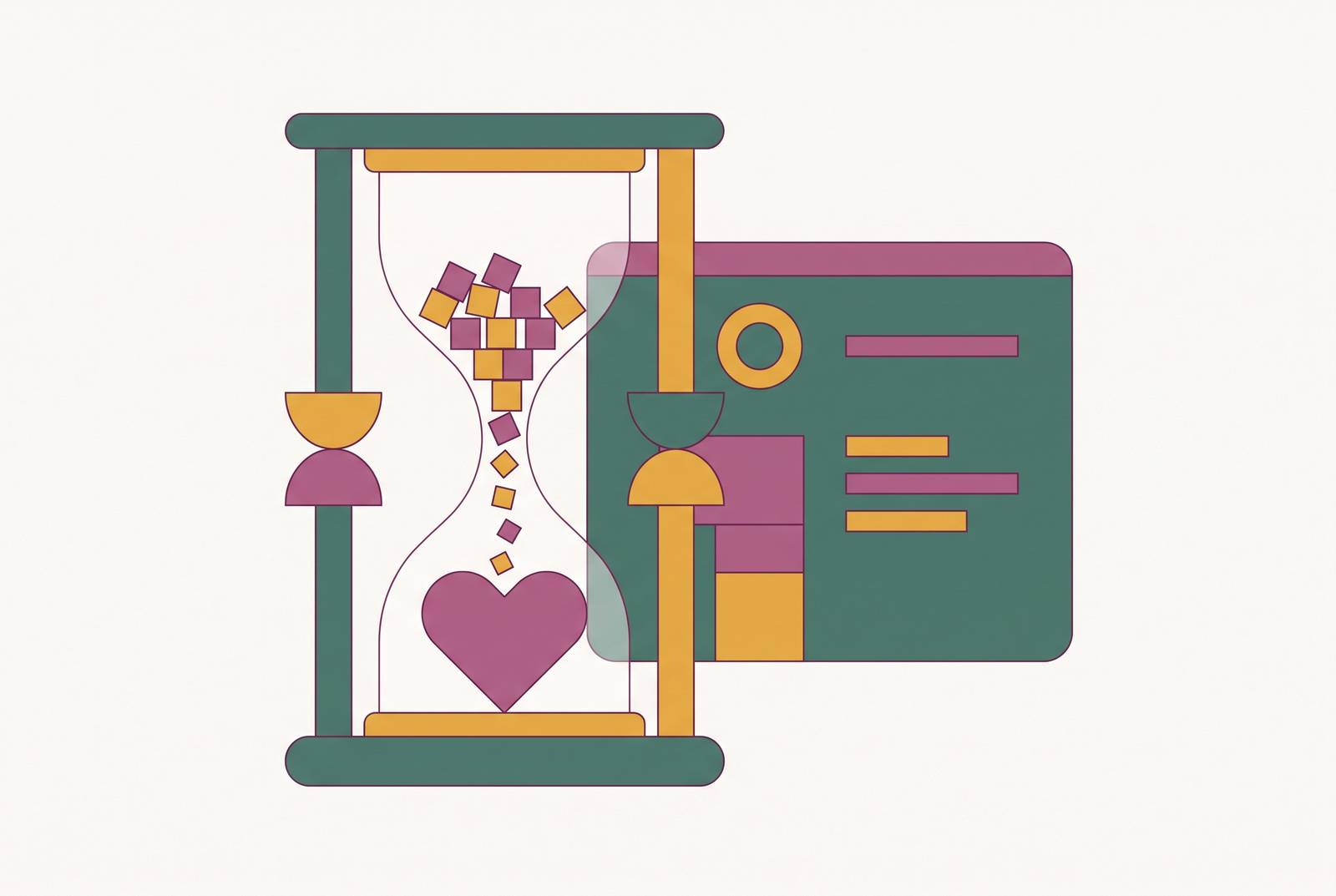
A wedding website has two timelines, and most advice collapses them into one question. The first is a clock question: how many hours does it take to build the site. The second is a calendar question: how many months before the wedding should it be live and doing real work for guests. These aren't the same measurement, and confusing them is why couples end up in one of two bad spots: rushing a launch the week before invitations go out, or sitting on a half-built site for months because they think it still needs more before it counts as ready. A couple who builds their site in a single afternoon but does it in the wrong month is still behind schedule. A couple who launches a bare-bones page with just a date and a location, at the right moment, is ahead even though their site is far from finished. Untangling these two questions is the only way to actually plan around either one.
What drives the build time
The technical part of building a wedding website is fast. A wedding-specific template on a purpose-built platform can go from signup to a shareable URL within a few hours, sometimes less, from a phone or a laptop. That few-hours window is the floor. The ceiling rises as soon as couples start layering in content: a couple story, travel logistics, accommodation blocks, FAQ answers, dietary fields on the RSVP form. Each of these adds incremental time, and it's the accumulation, not any single piece, that stretches a two-hour session into a multi-day project.
Carats & Cake ran live builds across nine platforms in August 2026 and found that ease of setup, specifically how long it takes to go from signup to a shareable URL, is one of the most practically important criteria couples should weigh, alongside design and price. Platform architecture matters here. WedBuild, for instance, runs on a single connected flow where the guest list, RSVP fields, dietary data, and the website itself all draw from the same data set. That means a couple entering a guest's name once doesn't have to re-enter it on a separate RSVP tool or a seating chart spreadsheet later. That kind of structural choice is what actually compresses setup time, more than any individual feature or template.
What couples need to gather before they can build
The platform is rarely the bottleneck. What slows couples down is sitting at the builder without the content ready to drop in, and then trying to write it on the spot. The couple story is the clearest example: "we met through a mutual friend" is accurate but says nothing, and figuring out which specific detail actually belongs on the page (where it happened, what was said, what stuck) takes longer than people expect when they're doing it live, mid-build.
FAQ answers have the same problem. Couples can't write these cold, because the questions worth answering, like parking, kids, dress code, what happens if it rains, and what to do about a late flight, only come to mind once someone thinks through the guest's actual day. Accommodation and travel logistics take time too: naming the hotel block, confirming the cutoff date, getting the direct booking link, mapping out airport and ground transport. And RSVP form logic, deciding which fields to include, like full name, meal preference, dietary restrictions, and attendance at any secondary events, needs to be settled before the form gets built, not worked out while building it.
The fix is sequencing. Writing the couple story, drafting the FAQ, and confirming accommodation details before ever opening the builder turns the actual build session into something closer to data entry than composition. Couples who prepare this way cut their build time roughly in half, simply because the hard thinking happened separately from the clicking.
When the site needs to be live, the calendar Australian couples face
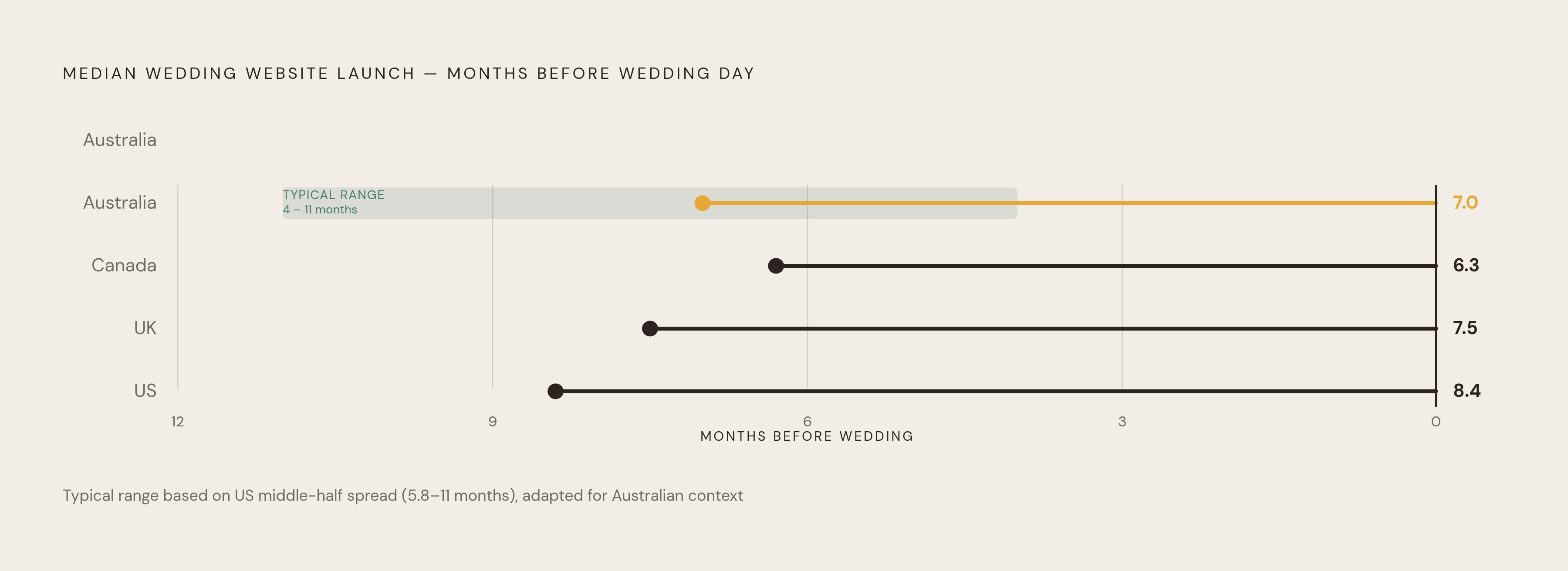
Once the build itself is sorted, the harder question is timing: when does the site need to exist. Australian couples tend to launch earlier than generic wedding advice assumes, but later than their counterparts in the US and the UK, and the median number alone doesn't tell the full story.
Bliss & Bone's data, drawn from more than 15,700 couples, puts the median Australian couple at 7.0 months before the wedding day when they launch their website. US couples median out at 8.4 months, UK couples at 7.5, and Canadian couples at 6.3. The 7-month figure for Australian couples is a midpoint, not a rule. Among US couples, where the fuller range is documented, the middle half launch anywhere between 5.8 and 11 months out, and a comparable spread likely holds for Australian couples too.
The practical reading: anything between 4 and 11 months before the wedding sits within normal range. Seven months is where most Australian couples land, not a deadline they need to hit. The real trigger for launching is whatever moment the venue and wedding date get locked in. Couples who haven't booked a venue yet haven't fallen behind on their website. They're simply still in the deciding phase, and the website timeline hasn't started for them yet.
Why the site should go live before it's finished
There's a real tension between launching early and not wanting to put up something unfinished. An incomplete site can feel like it's inviting the exact guest confusion a couple is trying to avoid. That concern is reasonable, but it gets the comparison backwards: a live site with just a date, a location, and a note that more details are coming is more useful to guests than a fully finished site that hasn't gone live yet.
Pine Lake Ranch's May 2026 guide points out that couples who delay often end up juggling spreadsheets, emails, and texts to track details that one central place could handle. The website exists to absorb those scattered questions, and it can't do that job sitting unpublished. Carats & Cake found that an incomplete website that's live is more useful than a perfect one that isn't.
The trigger for building and launching is locking the venue and date, not hitting some content threshold first. A clear placeholder, something like "full details coming soon, check back closer to the date," manages guest expectations far better than silence or a wave of individual text messages asking the same questions. This also matters because save-the-dates typically point guests to the website. If the site isn't live by the time save-the-dates go out, that link leads nowhere, and the couple has broken the one tool meant to field the questions they're trying to avoid answering one by one.
What to add across the planning window
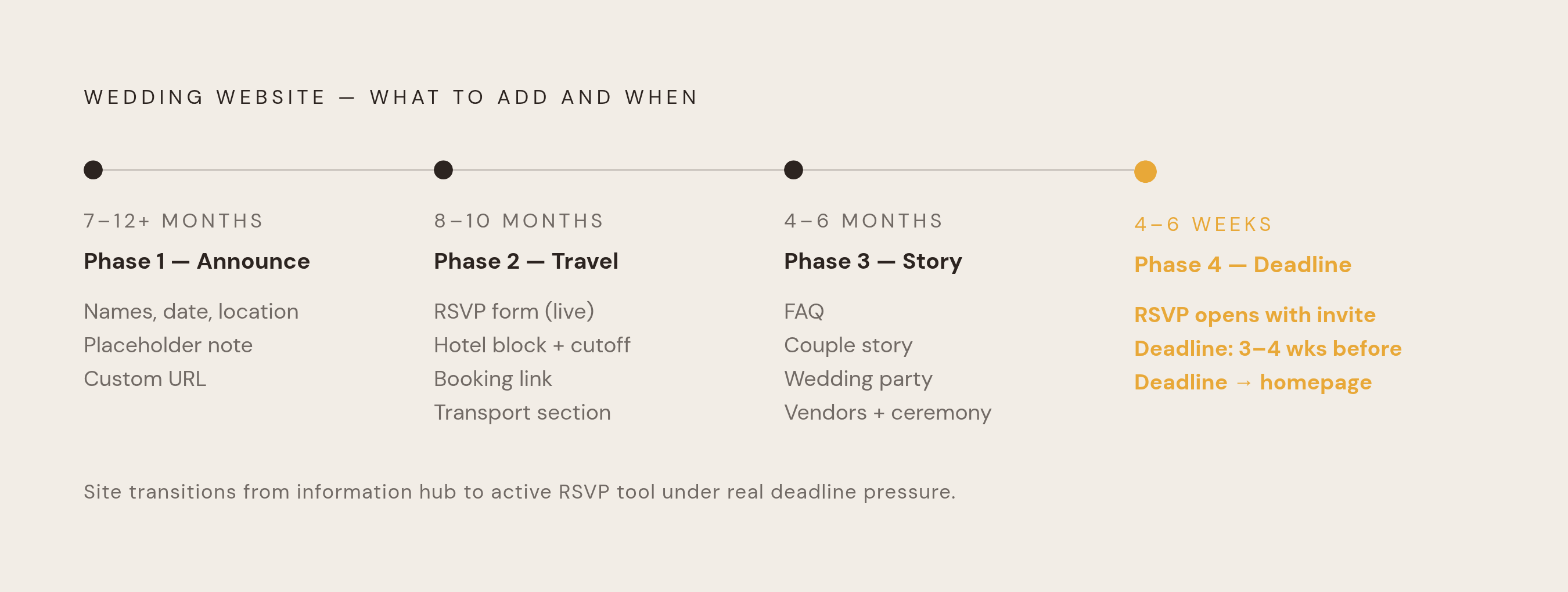
What separates a relaxed website setup from a last-minute scramble is spreading the content work across the right stages instead of trying to finish everything in one sitting.
The first phase lines up with venue and date lock, usually somewhere from 7 to 12-plus months out. At this stage, the site just needs names, a date, a location, and a note that more is coming. It's also the moment to secure the custom URL, before anyone else takes it. WedBuild's approach of connecting the wedding website to the guest list from day one means the site is already functioning as a data collection point the moment it's live, rather than waiting for an RSVP form to get bolted on later.
The second phase is around 8 to 10 months out. This is when the RSVP form gets activated, the hotel block name and cutoff date get added along with a direct booking link, and the travel and transport section comes together. Carats & Cake identifies the RSVP section as where most couples leave accuracy on the table. Building the form correctly at this stage, with full name, meal preference, dietary restrictions, and secondary event attendance all accounted for, prevents a data-cleaning mess closer to the wedding.
The third phase runs roughly 4 to 6 months out. The FAQ and travel sections get completed, the couple story and wedding party introductions go up, and any confirmed vendor or ceremony details get added. The FAQ in particular should keep evolving as actual guest questions come in, because those questions expose gaps the couple never thought to cover.
The fourth phase is 4 to 6 weeks out. The RSVP form opens alongside the formal invitation, with a deadline set 3 to 4 weeks before the wedding. That buffer gives time to chase down non-responders before the venue needs a final headcount, typically two weeks out. One month before the wedding, the RSVP deadline should move front and center on the homepage, since guests opening the site for the first time this late need to see it immediately, not dig for it.
Why the RSVP form is the most consequential part of the site to get right
The wedding website is the front end of a data collection chain, and the RSVP form feeds the caterer, the seating chart, and the logistics of the day itself. A well-built form collects full name, not just a first name, since that detail matters for seating, along with meal preference, dietary restrictions or allergies, and attendance at any secondary events.
The biggest cause of incomplete RSVP data is friction at the point of submission. Forms that require guests to log in or create an account see people abandon the process. A form that skips the login requirement and works cleanly on a phone cuts down the follow-up work dramatically, because fewer guests give up halfway through.
WedBuild's automatic sync between dietary data and the seating chart means information entered at RSVP flows straight through without anyone having to manually reconcile two separate lists. That reconciliation step is exactly the kind of thing couples otherwise discover needs doing the night before the wedding, at the worst possible time to be doing it. Getting the form built correctly, with the right fields and no login barrier, is a planning decision made months in advance, not a detail to patch at the last minute.
How platform choice affects both timelines
Platform choice affects both the hours it takes to build and the months over which the site gets built. A well-designed tool shortens the build session and makes the phased launch model realistic to follow. A poorly integrated one adds friction at every stage along the way.
For Australian couples, platform integration matters most. A platform where RSVPs land in one system and the guest list lives in another recreates the exact spreadsheet problem couples were trying to get away from: dietary data has to be re-entered, headcounts have to be reconciled by hand. WedBuild connects the wedding website, guest list, RSVPs, digital invitations, seating chart, and dietary data into a single flow, so information entered once doesn't need to be typed in again somewhere else. That design principle is what makes the phased build model workable. WedBuild is also free to start, with optional paid upgrades and no subscription required from day one, which matters for a tool couples will be using across a planning window that can stretch past 12 months.
Australian couples also run into structural mismatches with platforms built for the US market. Registry integrations that require a US bank account, vendor directories with no Australian listings, and budget benchmarks quoted in USD are signs the platform wasn't built with Australian venues, seasons, or currency in mind. A platform designed around how Australian couples actually plan, where outdoor contingency details, travel distance, and accommodation blocks are built into the site structure from the start rather than added as an afterthought, answers the specific questions Australian guests tend to ask. Another platform takes a different angle on this same problem with an AI budget planner priced in AUD and benchmarked to Australian cities and vendor categories, which is useful for couples who want AU-calibrated budget tools running alongside their website.
The honest verdict for Australian couples is that free works fine for the website itself. The real case for paying is the planning infrastructure wrapped around it: RSVP management, dietary data tracking, seating logistics, not the website design in isolation.
What "done" looks like at each stage
"Done" doesn't mean the same thing at every point in the planning window, and that's the piece of confusion this whole question comes down to. A site that's correctly done at 10 months out will look sparse by design, and that's the model working as intended, not a sign of falling behind.
At launch, somewhere between 7 and 12-plus months out, done means a date, a location, the couple's names, and a placeholder note that more details are coming, which is shareable and functional even though it's sparse. By the time invitations go out, roughly 6 to 8 weeks before the wedding, done means the RSVP form is live and tested, the hotel block is active, the FAQ is answered, and the travel section is complete, because the site now needs to handle real guest traffic. In the week of the wedding, done means the final headcount is locked in, the dietary summary has gone to the caterer 2 to 3 weeks prior, the RSVP form is closed or its deadline has passed, and a QR code or direct link is ready for day-of use.
After the wedding, what happens to the site depends on the platform. Free platforms generally keep the site live indefinitely but may strip out certain features once the wedding date passes. Paid platforms typically end hosting when the subscription or term runs out. Either way, couples who want the photo gallery or guest messages to stay accessible long-term should download a full backup, regardless of which platform hosted the site.
The real question running through all of this is which version of the site is needed right now, and what it needs to do at this point. Answering that question freshly at each stage, rather than treating the whole site as one project with a single finish line, is what keeps a wedding timeline calm instead of compressed.